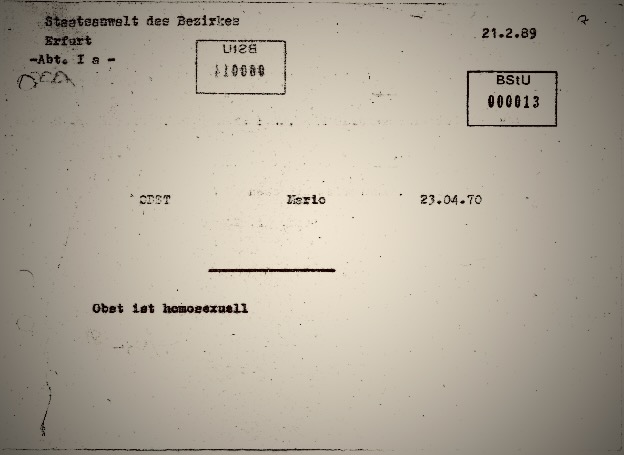
I never made a secret of being gay. Yet the state apparatus considered it necessary to record that very fact in my file on 21 February 1989.
Coming out at 14
I was 14 when I came out. First, I told my parents. Then I stood in front of my entire class and said openly that I was gay. My classmates knew, my teachers knew — and word soon spread around the school.
Later, people around me during my training as a tailor knew as well. I was not afraid to say it and did not try to hide an essential part of who I was. For anyone who knew me, my homosexuality had long ceased to be a secret.
East Berlin, my first great love and the Schoppenstube
Even as a teenager, I often travelled to East Berlin. It was also where I found my first great love. With friends from East Berlin, I frequently visited the Schoppenstube on Schönhauser Allee. It was one of the best-known meeting places for gay men and lesbians and was often described as a centre of gay life in the GDR.
For me, above all, it meant community: meeting people, seeing friends and being able to take who I was for granted for a few hours. Yet this space was watched too. The Stasi monitored gay and lesbian communities, deployed unofficial collaborators — its informants — and covertly “secured” meeting places. Historical accounts even identify three full-time Ministry for State Security (MfS) officers assigned to the Schoppenstube. Guests could not tell who was simply enjoying the evening and who was watching or reporting.
From the Stasi’s perspective, my regular trips to East Berlin, my relationships and friendships, and my openness in this community apparently made me all the more worth recording.
No secret — yet still on file
That makes this single sentence seem all the more absurd to me today. A sheet headed with the name of the Public Prosecutor of the Erfurt District and dated 21 February 1989 contains just this statement: “Obst is homosexual.”
What everyone around me had long known was recorded, passed on and preserved by the state apparatus. My sexual orientation became a piece of information that the authorities believed belonged in a file.
My “official certificate”
Today, with a certain irony, I see this note as my “official certificate from the Ministry for State Security” — certifying that I am, quite simply, gay. How many people can say they have one of those?
That may sound macabre. But age sometimes changes how we look at documents like this. Humour does not make the system of the time any less oppressive. It helps me reclaim this sentence today: what could once be monitored and used against people is, for me, neither a flaw nor a secret.