20 April 1989
In the German Democratic Republic (GDR), many people were persecuted for political and personal reasons. The Stasi, the country’s secret police, played a central role in the surveillance and conviction of citizens. One particular example considered here is the case of Mario Obst, whose criminal proceedings are documented in Stasi records.
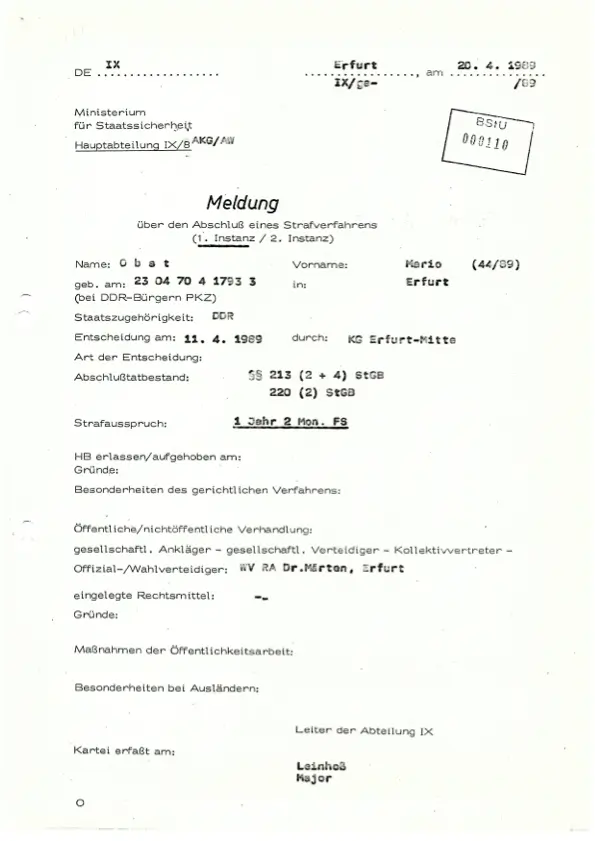
The criminal proceedings: an overview
The decision in the criminal proceedings against Mario Obst was made on 11 April 1989 at the Erfurt-Mitte local court. Mario Obst was convicted under Section 213 of the GDR Criminal Code and Section 220(2). The document does not set out the precise wording of the charges, but gives the sentence as one year and two months’ imprisonment. This report documents the conclusion of the proceedings, as well as aspects of what happened in the preceding days and weeks.
Hearing and decision
The printed form contains a field for a public or non-public hearing, but it has not been completed. This document therefore does not establish whether the hearing was public. The notification records the roles of those involved in the proceedings. The Erfurt lawyer Dr Märten is named as defence counsel; the names of judges and prosecutors are redacted in the documents made available here.
The document’s significance
This document offers insight not only into the bureaucracy of East German state power, but also into the mechanisms through which people such as Mario Obst were persecuted and punished. For historians and eyewitnesses, it is a valuable historical record illustrating the methods and procedures of the GDR’s Ministry for State Security.
Appeals and measures
The entry for appeals lodged consists of two dashes. The form also contains headings for publicity measures and special circumstances concerning foreigners, but these are uncompleted. Those headings alone are not evidence that such measures were taken in this case.
Closing thoughts
Mario Obst’s story and the associated criminal proceedings exemplify how the East German government controlled its citizens and used the Stasi as an instrument of surveillance and repression. Today, documents such as these help us learn more about life in the GDR and about the development of society and the legal system under an authoritarian regime.
This case reminds us how important it is to understand the past, learn from it and ensure that the mistakes of history are not repeated.
It reminds us how important it is to understand the past, learn from it and ensure that the mistakes of history are not repeated.