4 April 1971
The Chairman of the GDR’s Council of State, Comrade Walter Ulbricht, became Mario Obst’s honorary godfather.
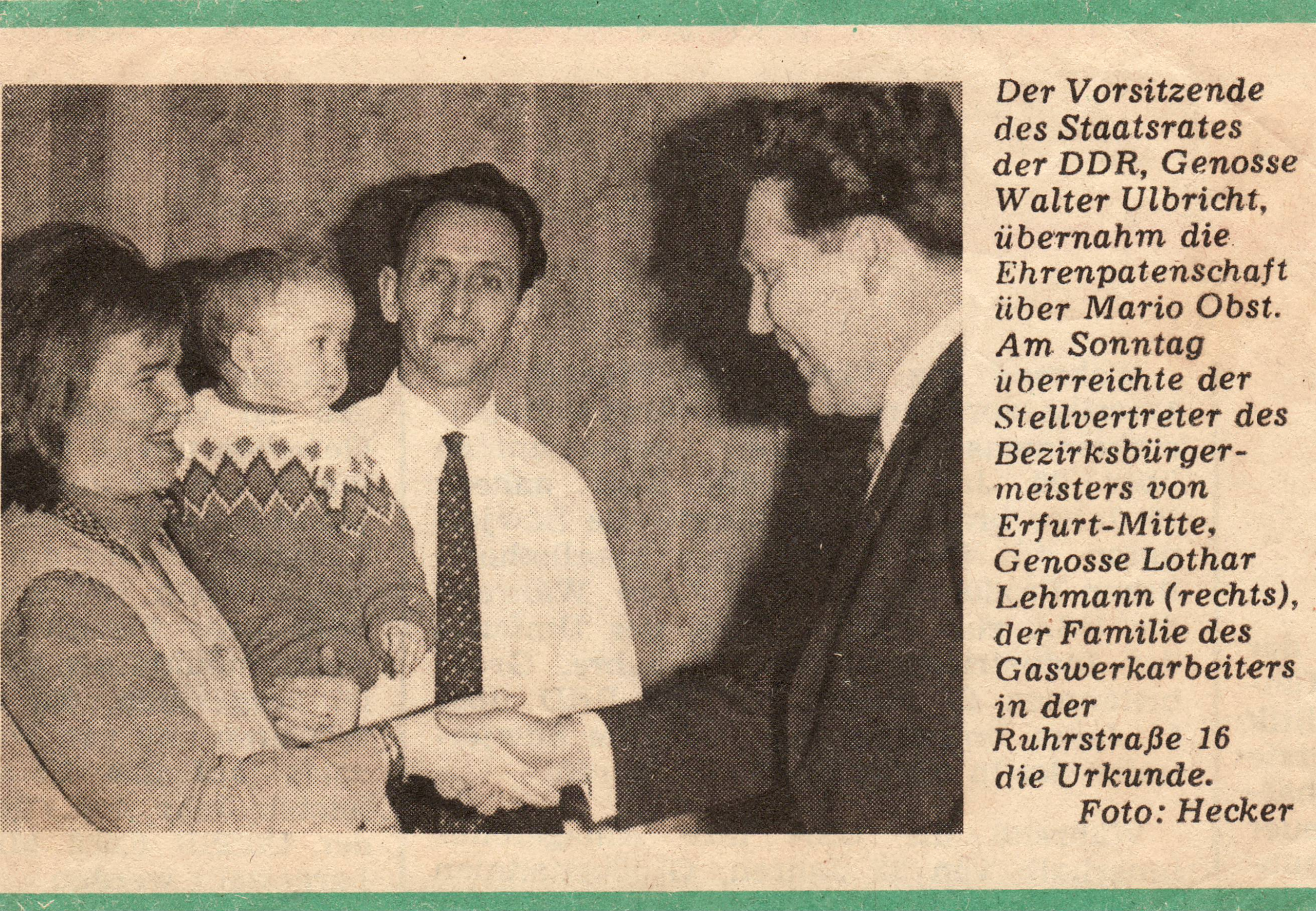
And so Mario Volker Obst became Mario Volker Walter Obst.
On Sunday, 4 April 1971, the Deputy Mayor of Erfurt-Mitte, Comrade Lothar Lehmann (right), presented Mario’s honorary sponsorship certificate to the gasworks worker’s family at 16 Ruhrstraße.
Walter Ulbricht — an architect of the East German dictatorship
Walter Ulbricht was one of the defining figures of Germany’s post-war history. As General Secretary of the Socialist Unity Party of Germany (SED) and later head of state of the GDR, he decisively shaped political and social developments in eastern Germany for more than two decades. His role in establishing a socialist state, his authoritarian leadership and his central involvement in building the Berlin Wall make him one of the most controversial figures in contemporary German history.
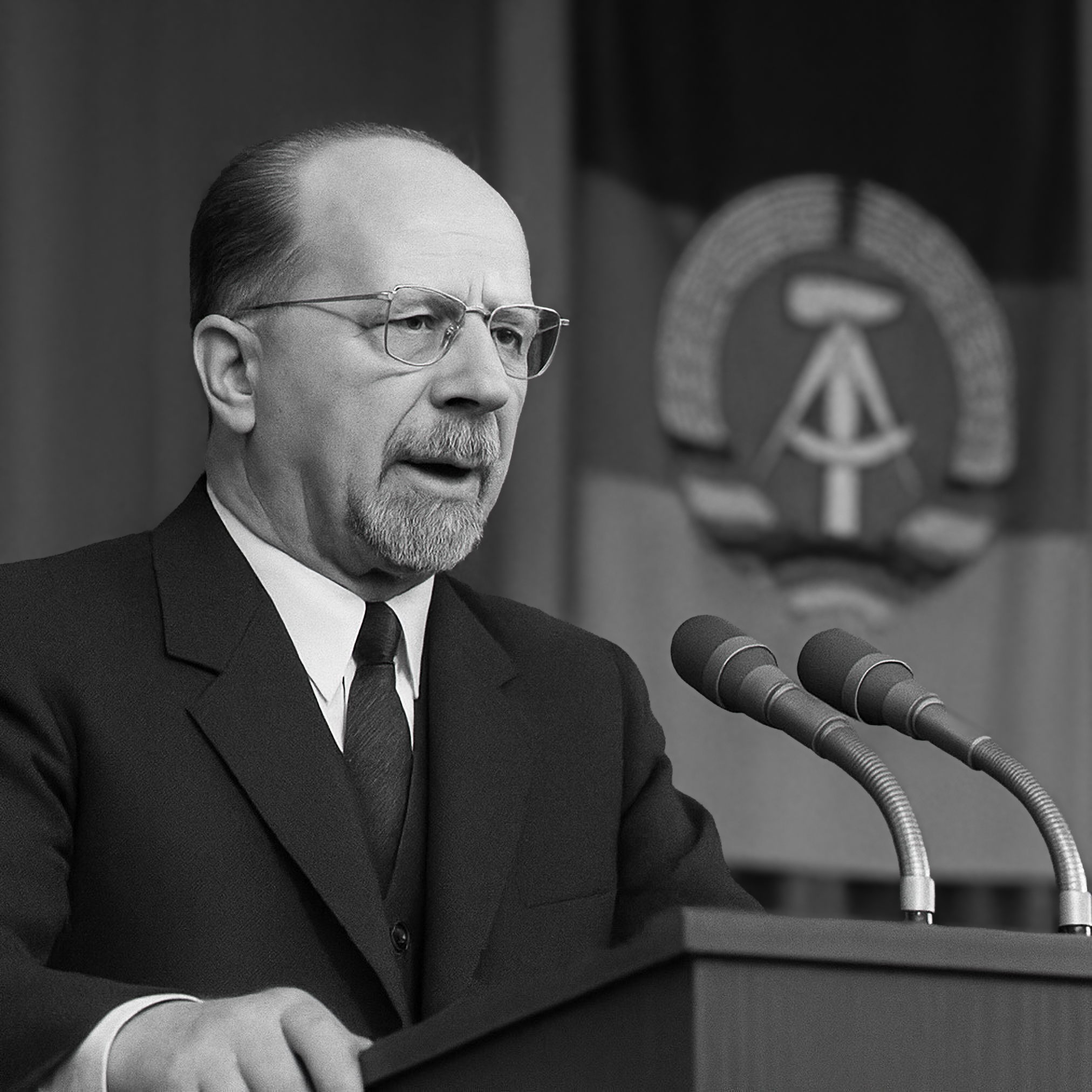
Born in Leipzig on 30 June 1893, Ulbricht became involved in the labour movement at an early age. After the First World War, he joined the Communist Party of Germany (KPD) and quickly rose through its leadership. He worked as a KPD official during the Weimar Republic. After the National Socialists came to power, he fled into exile, first to Czechoslovakia and later to the Soviet Union.
In 1945, Ulbricht returned to Germany with the so-called Ulbricht Group. Under Soviet supervision, he began establishing a communist state system in the Soviet occupation zone. As a co-founder of the SED, he pushed for eastern Germany to be reshaped along Soviet lines. In 1950, Ulbricht was elected First Secretary of the SED Central Committee — making him, in practice, the most powerful man in the GDR.
His time in office was marked by the forced collectivisation of agriculture, the expansion of the planned economy and the harsh suppression of political opponents. Internationally, he became notorious above all for his role in building the Berlin Wall in August 1961 — an event that separated millions of people and entrenched Germany’s division. His attempts at economic reform, such as the “New Economic System”, ultimately failed and were soon abandoned.
In 1971, increasingly isolated and in poor health, Ulbricht was replaced by Erich Honecker under pressure from the Soviet leadership. Two years later, on 1 August 1973, he died in Groß Dölln, Brandenburg.
Walter Ulbricht left a deep mark on German history as a planner and executor of a dictatorial regime built on control, surveillance and isolation. His role remains a subject of historical debate.
His greatest lie
“No one has any intention of building a wall.”
Watch footage of this press conference: Walter Ulbricht’s statement on YouTube (German).