My future was decided without me
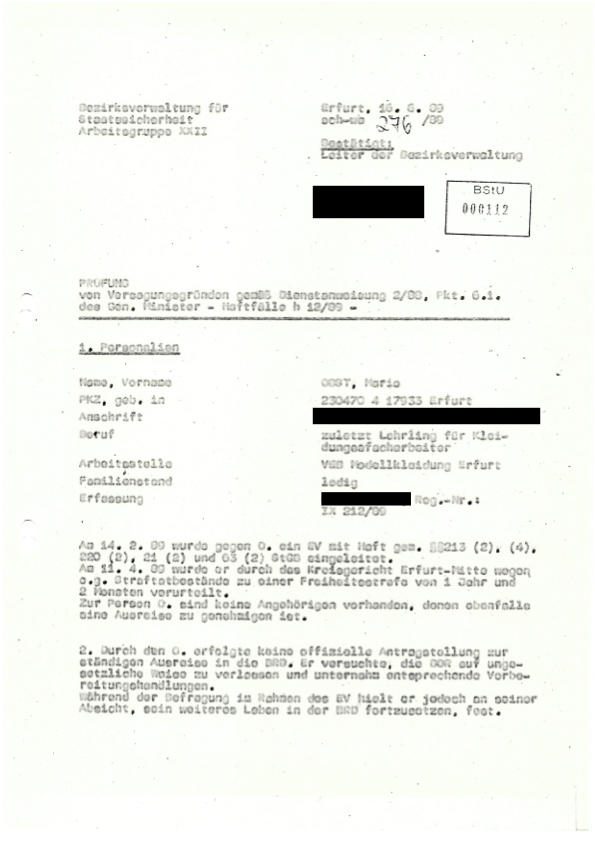
On 16 June 1989, Working Group XXII of the Erfurt District Administration for State Security summarised the results of its review. The question was whether I could leave prison for West Germany — or, as I would put it more accurately today, whether they wanted to deport me from East Germany after my imprisonment.
The file records my arrest on 14 February 1989, my sentence of one year and two months in prison, and my vocational training at the time. It then states explicitly:
“O. did not submit an official application for permanent emigration to the Federal Republic of Germany.”
I had never applied to emigrate
That sentence is correct. At no point had I submitted an official application to emigrate. Why would I? Even then, my position was clear: You do not apply for freedom. I did not want to ask permission to leave East Germany. I wanted to make my own decisions about my life and find my way to freedom.
During interrogations, I maintained that I wanted to live in West Germany. I also made a deliberate choice of lawyer: Professor Dr Wolfgang Vogel in Berlin. Vogel was the central intermediary between East and West Germany in the release of political prisoners in exchange for payments. Choosing him as a lawyer made it unmistakable that you wanted just one thing: to get out of East Germany.
Looking back: my perspective
On a list — and turned into a commodity
By choosing Wolfgang Vogel, I feel today that I effectively put myself on a waiting list. Nowadays, one might call it a “shopping list”. In the prisoner release transactions, East Germany received material compensation from the West for releasing political prisoners.
My life, too, became the subject of negotiations between states. East Germany could still obtain an economic benefit from an imprisoned person, receiving coveted foreign currency or goods from the West. For me, a bitter thought remains: I became a commodity.
The sheets shown here document the internal preparation and approval of my emigration directly from prison. These four pages alone do not establish whether my name was subsequently placed on a prisoner release list, or under which specific agreement.
What the file claims about my motives
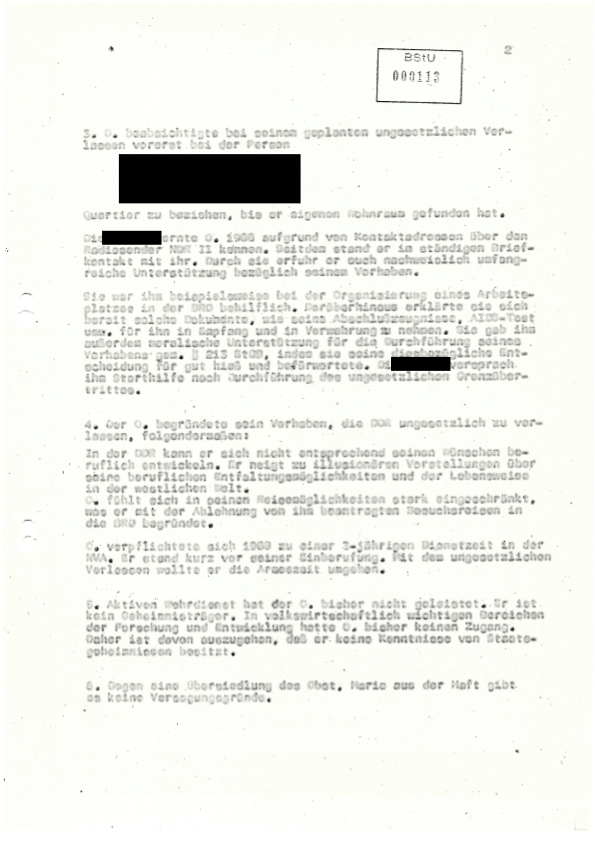
The document states that I had been unable to develop professionally as I wished in East Germany, that I had “illusory ideas” about my career prospects in the West, and that I had felt severely restricted in my opportunities to travel.
My wish for professional freedom was real. I had already enjoyed success with my fashion designs and wanted to go to Paris. What the file disparaged as an illusion was, for me, a concrete hope of living a life of my own choosing.
The file’s claim and my recollection
Ten years as a career non-commissioned officer
The record also connects my escape plan with my forthcoming call-up to the National People’s Army and refers to a commitment to three years of service. That account does not match my recollection.
Even at school, young people were approached by military recruitment officers and pressed to choose a longer career in the National People’s Army. At my medical examination, when I was about 17, I was subjected to pressure until I signed a commitment to serve for ten years as a career non-commissioned officer. It was not a three-year officer’s career.
This planned military future also involved suitable vocational training. Immediately after school, without my having to apply, an apprenticeship as a machinery and plant fitter was arranged for me. It suited the intended role: I would later be able to repair “my” tank, too.
I left that apprenticeship. It was not because I lacked technical ability, but because I faced serious problems with other apprentices as an openly gay teenager. My supervisor at the time did not care that I was gay; he valued my abilities.
I was not trying to escape military service. My decision to leave East Germany grew out of my wish for personal, professional and social freedom, rather than an attempt to avoid serving in the military.
No “grounds for refusal”
Finally, the Stasi noted that I had not engaged in “active hostile activity”, had not held classified information, and had not had access to areas of research and development important to the national economy. In its assessment, I therefore had no knowledge of state secrets.
“There are no grounds for refusing the resettlement of Obst, Mario, directly from prison.”
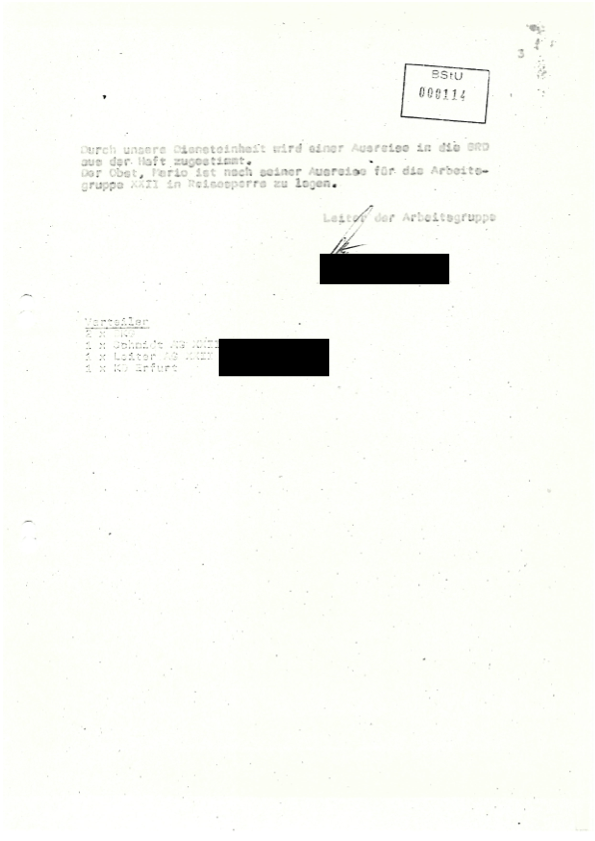
The concluding sheet, BStU 114, states: “Our service unit approves emigration to the Federal Republic of Germany directly from prison.”
From the perspective of the unit involved, the decision was made: the East German state saw no further reason to keep me in the country after my release. I had never applied to emigrate, yet my permanent departure was being prepared.
Source note: The illustrations show only the PNG files I provided. Existing redactions have not been removed or reconstructed. Direct quotations are restricted to clearly legible passages. My personal recollections and corrections are explicitly identified as such.
Historical context: From 1963, Wolfgang Vogel was East Germany’s state representative for the release and exchange of political prisoners. According to the Federal Foundation for the Study of the Communist Dictatorship in Eastern Germany, he arranged the release of 33,775 prisoners in exchange for payments. The Federal Archives describes how East Germany viewed these transactions in the context of lending and trade between the two German states. Federal Foundation: Wolfgang Vogel · Federal Archives: records on prisoner release transactions