21 February 1989
The role of state security in the GDR: surveillance and discrimination
The Stasi, the secret police of the German Democratic Republic (GDR), played a central role in monitoring its citizens. It systematically watched not only political opponents, but also people considered “suspicious” for other reasons, such as their sexual orientation. Homosexuality was one subject of this documented persecution.
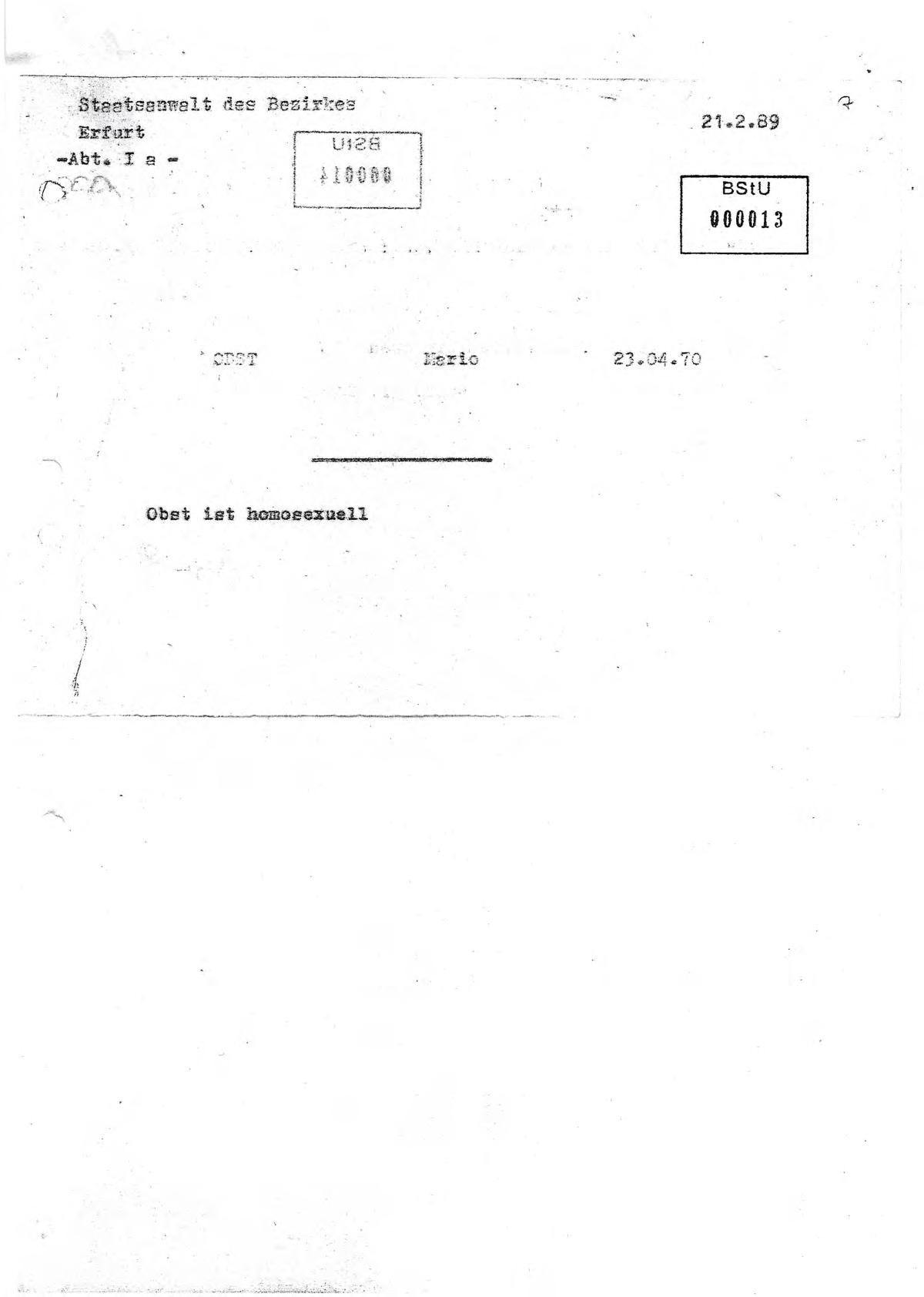
My 1989 Stasi file includes Mario Obst with the note “Obst is homosexual”. This note represents the treatment of homosexual people in the GDR, where they were systematically discriminated against and often persecuted.
Social attitudes in the GDR
Homosexuality was a taboo in the GDR for a long time. The 1968 criminal-law reform ended the criminalisation of consensual homosexual acts between adults; a discriminatory provision concerning young people remained. Social stigma continued. The Stasi often regarded it as a sign of “deviation” from social norms, leading to surveillance and spying. People considered homosexual faced the prospect of constant observation and discrimination.
The Stasi’s role
The Ministry for State Security used its extensive files to monitor every aspect of citizens’ lives. This included collecting information about sexual orientation. Such records were later used as incriminating material to blackmail people, control them and silence them.
The note in my Stasi file shows how far this surveillance extended and how homosexuality was perceived as a threat to the “normal” social order.
Coming to terms with the past
After German reunification, many Stasi records became accessible to the public. This helped bring the dark sides of the East German dictatorship to light. Homosexuality and the role of the Stasi in persecuting homosexual people are now important parts of examining this history.
It is vital that records and stories like these are not forgotten, so that similar forms of discrimination are not repeated. Remembering the surveillance and persecution of homosexual people in the GDR is an important part of collective memory and of confronting the past.
Addendum
The Stasi’s obsession with order — even in private life
The GDR’s Ministry for State Security was known for meticulously recording and preserving everything, however personal or trivial the information. My Stasi file contains a note dated 21 February 1989, written by the Public Prosecutor of the Erfurt District at the time: “Obst is homosexual.”