11 April 1989
A verdict on my wish for freedom
On 11 April 1989, I was brought before the criminal division of Erfurt-Mitte Local Court. I was 18 years old and had been held in the Ministry for State Security’s remand prison in Andreasstraße since 14 February.
My plan had been to leave East Germany on 16 February, travelling through Czechoslovakia and Austria to West Germany. Two days earlier, the Stasi had arrested me at work. What I saw as an attempt to decide my own life and future was now being used against me in the language of East German criminal law.
The court sentenced me to one year and two months’ imprisonment for “preparation for an unlawful border crossing” and “public denigration”.
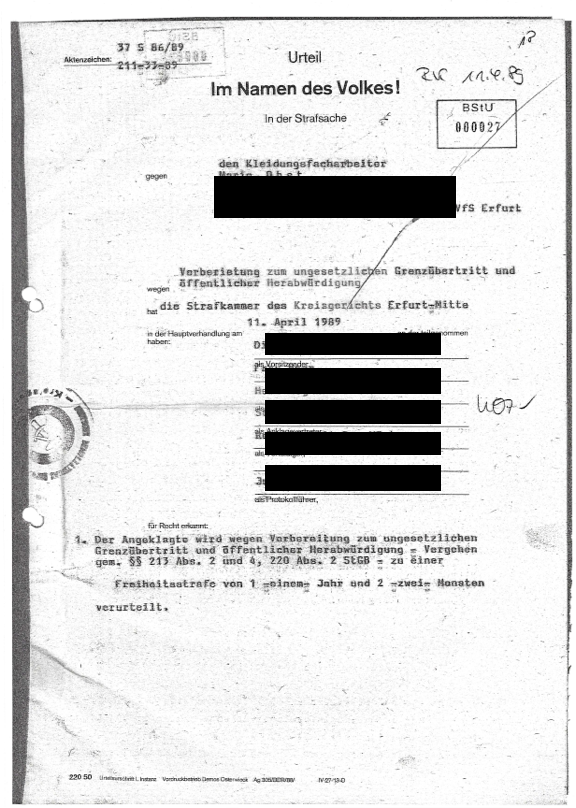
What the document records
The first page gives my name, date of birth, the charges and the sentence. It also lists the court and the people involved in the proceedings. This dry enumeration conceals what it really meant to me: I wanted to live freely and make my own decisions.
The judgment is therefore not a neutral report about me. It uses the terms of a state that criminalised the wish to leave one’s own country without permission. I publish it because it reveals how my wish for freedom was turned into a criminal case, without adopting its language as my own.
From Erfurt to Cottbus and Karl-Marx-Stadt
After my conviction, I was taken to prison in Cottbus. The former prison is now the Cottbus Human Rights Centre.
From mid-September 1989, I was held in a prison in Karl-Marx-Stadt. I spent most of my time alone in a cell and had no contact with the outside world. On 20 October 1989, I was taken away from there. I describe that day in “Until 20 October 1989”.
1993: the judgment is overturned
On 21 April 1993, Erfurt District Court declared this judgment contrary to the rule of law and overturned it insofar as it concerned me. The decision states that the conviction had served the purpose of political persecution and grants me judicial rehabilitation. The sequence of events and the redacted decision are documented in My rehabilitation.
The visit that could no longer take place
My mother Rosemarie’s next visit was scheduled for 13:30 on 11 April 1989. But my trial took place on that very day. The visit was cancelled.
My mother was the only relative allowed to sit in the public gallery of the courtroom. She was physically close to me, yet was not allowed to sit opposite me as my mother, speak to me or hold me. She had to watch as her son was sentenced to one year and two months in prison.
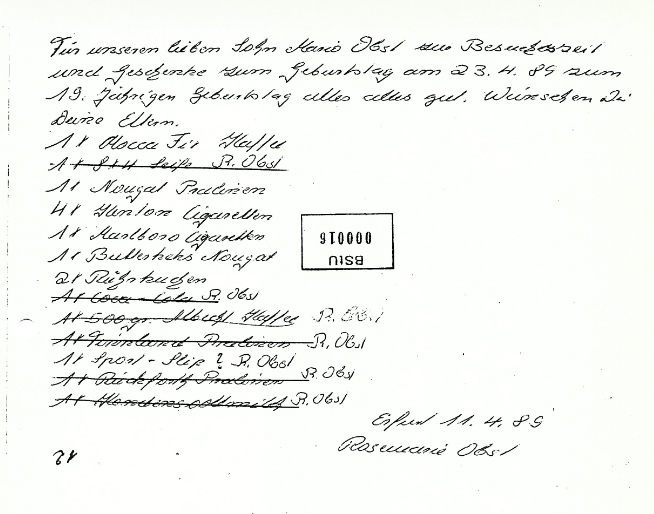
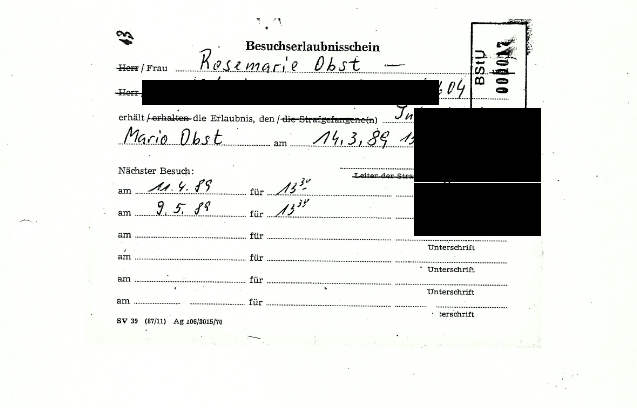
She had brought various things for this visit that never took place. I did not receive many of them. Several items were crossed out on her handwritten list. At the same time, she was already thinking of my approaching 19th birthday on 23 April and wrote her wishes for me on the sheet.
Today, I carry my mother’s first name as part of my own name: Rosemarie. Her name belongs forever to me, as well as to this painful memory. On mvwbro.com, I explain how Mario Obst became Mario Volker Walter Bernhard Rosemarie Obst over the course of my life.
Source: Federal Archives — Stasi Records Archive, documents from my prison file. To protect privacy, personal identification numbers, the private address at the time, and staff names, signatures and handwritten entries have been permanently redacted. My mother Rosemarie’s name and signature remain visible with my consent. Only newly rasterised image files are published, rather than the editable source documents.