Return to the brief overview. Here you will find the detailed chapters and their references. Choose the topic that interests you from the contents.
Understanding a secret police organisation requires looking at its structures alongside people’s experiences. Andreasstraße in Erfurt brings the two together.
This section aims to explain the history of the Ministry for State Security and connect it with Erfurt’s history. Its focus is political persecution and pre-trial detention. My personal account (Mario V.W.B.R. Obst) offers a concrete way into the subject. Research and publicly accessible sources on Erfurt’s history supplement it.
Research accounts, contemporary files and personal recollections serve different purposes. The following sections identify their evidence. My experiences represent one individual life. Findings from my case are not extended to other prisoners without further evidence.
Historical foundations · 1945–1950 and early dependencies
Background and foundation of state security
The foundation of the Ministry for State Security on 8 February 1950 had its roots in the Soviet occupation zone. Soviet security bodies and an emerging German political police force laid the groundwork. From 1948, the SED pressed for a secret police organisation of its own. During 1949, a separate state security apparatus was built from the preceding structures. After the GDR was founded, it initially operated within the Interior Ministry as the “Main Administration for the Protection of the National Economy”; this became the MfS in 1950. The new authority was to persecute opponents of the emerging party regime and secure its power.[1], [51]
To understand this history, it is therefore necessary to distinguish the formal founding date from the older structures of political persecution. Starting the story only in 1950 loses sight of these foundations. Conversely, describing every instance of political imprisonment since 1945 as “Stasi imprisonment” obscures the differences between occupation authorities and later East German institutions.
After 1945: occupation rule and political persecution
The end of the Second World War marked the beginning of a new political order in the Soviet occupation zone. Prosecuting Nazi crimes and building a dictatorship cannot simply be equated. Jörg Echternkamp and Peter Lieb describe tensions between the punishment of actual Nazi crimes, political “purges” and arbitrary terror. Soviet military tribunals and security bodies were central actors. Arrests also affected people against whom no individual criminal offence had been proved.[49]
The Soviet special camps formed part of this system of rule. Internment without trial must be distinguished from imprisonment following a Soviet military tribunal’s judgment. Internees included former Nazi functionaries, but also people who had held no such positions. From 1947, persecution of real or perceived opponents of the new political order increased. In Thuringia, the special camp at Buchenwald is an important part of this history.[49]
This background explains why political imprisonment must be examined before the MfS’s foundation as well. However, a Soviet special camp was not an MfS remand prison. For every place of detention and individual case, the period, responsible authority and type of detention must be established. The later Andreasstraße prison can thus be placed in a wider context without conflating different institutions.
1947: political policing within the criminal police
A German political police force initially developed within existing police structures. In the MfS encyclopaedia, Roland Wiedmann describes the reorganisation of the criminal police in the German Administration of the Interior. In the first quarter of 1947, a K 5 section was created to carry out assignments for German and Soviet authorities. From this point onwards, K 5 should be regarded as a political police force. Its designation, however, was intended to conceal that character from the outside world.[50]
Its tasks combined denazification with action against politically unwanted activities. Alongside investigations into Nazi organisations, Wiedmann mentions measures against supporters of social democracy and people labelled “Trotskyists”. The actual operational work took place primarily in the regional states. K 5 was therefore a precursor to the later MfS, rather than an independent ministry.[50]
1948/49: towards a state security apparatus of its own
The MfS’s creation was neither solely a Soviet instruction nor exclusively a German decision. Roger Engelmann describes the SED leadership’s pressure for its own state security apparatus. Stalin agreed in December 1948, despite opposition from Soviet state security. Its establishment in 1949 followed the Soviet model and remained under close Soviet control. The Main Administration in the Interior Ministry was the immediate precursor of the ministry founded in February 1950.[51]
In terms of political responsibility, its establishment combined the SED leadership’s interests with the occupation power’s authority to make decisions. The organisation arose within this relationship of power. Soviet influence explains some of its structures and methods; it does not remove the German participants’ responsibility for their own actions.
A ministry whose powers were not publicly explained
Walter Süß describes the founding law as exceptionally brief: it announced the ministry’s establishment without explaining its tasks or powers. More precise provisions followed in secret statutes. The 1953 statute listed the SED leadership’s decisions ahead of state laws and regulations as the basis for its work. In the 1969 statute, too, the party programme and decisions of the Central Committee and Politburo came first.[2]
When reading this history, public laws alone therefore do not explain how the apparatus actually functioned. Internal instructions and the practices of political leadership must also be examined. An authority’s name tells us little about whom the institution answered to.
The 1950s: direction by Soviet advisers
Founding a separate ministry did not initially mean independent leadership. Engelmann describes Soviet instructors or advisers in the MfS’s most important service units. In practice, they had powers to issue instructions and exercise a veto. The Soviet intelligence chief in Berlin-Karlshorst also personally directed the head of East German state security. Here, “advice” therefore meant considerably more than professional assistance.[52]
This relationship changed. According to Engelmann, the SED leadership gained greater influence over its own state security affairs in 1957; in 1958, the MfS became more independent.[51] The advisory apparatus was dissolved in November 1958. Liaison officers remained, but no longer had authority to issue instructions to the MfS.[52] The form of cooperation thus changed. Nevertheless, the connection with Soviet state security and its influence continued.[51]
Examining these changes prevents a static picture of the entire East German period. Direct Soviet direction must be taken into account for the early 1950s; different decision-making processes must be examined for later decades. The following chapter on the Stasi and the SED therefore turns to the apparatus’s political leadership and scope for action.
Political responsibility
The Stasi and SED rule
State security emerged within the SED dictatorship. Jens Gieseke stresses that responsibility cannot be examined solely through officers or informants: the SED leadership founded the MfS and directed its activities of persecution. Political responsibility for the system therefore belongs to the Stasi’s own history.[3]
This perspective prevents the story being reduced to individual “spies”. The political authorities commissioning the work, and the staff who requested information, managed sources and organised measures, must also be examined. Individual participants’ responsibility must be assessed through their actions; naming a role does not replace that examination.
Political leadership and scope for independent action
Süß shows that political direction came primarily from the SED leadership, rather than the party organisation within the MfS. For the Honecker era, he describes direct discussions between the party leader and the Minister for State Security. Mielke’s privileged access also strengthened his position relative to other parts of the party apparatus. Subordination to the party and the minister’s influence therefore existed side by side.[2]
As a historical interpretation, this suggests that state security had considerable influence while remaining embedded in political rule. Its relationship with the leadership changed over the decades. Specific events require examination of the level at which decisions were made and the scope for local action.
Historical overview · 1950–1989
From early terror to a comprehensive surveillance apparatus
The apparatus of the late 1980s was the result of a long development. The following stages provide an initial orientation. Further detailed chapters will supplement them as this section develops.
1953: popular uprising, persecution and changes in leadership
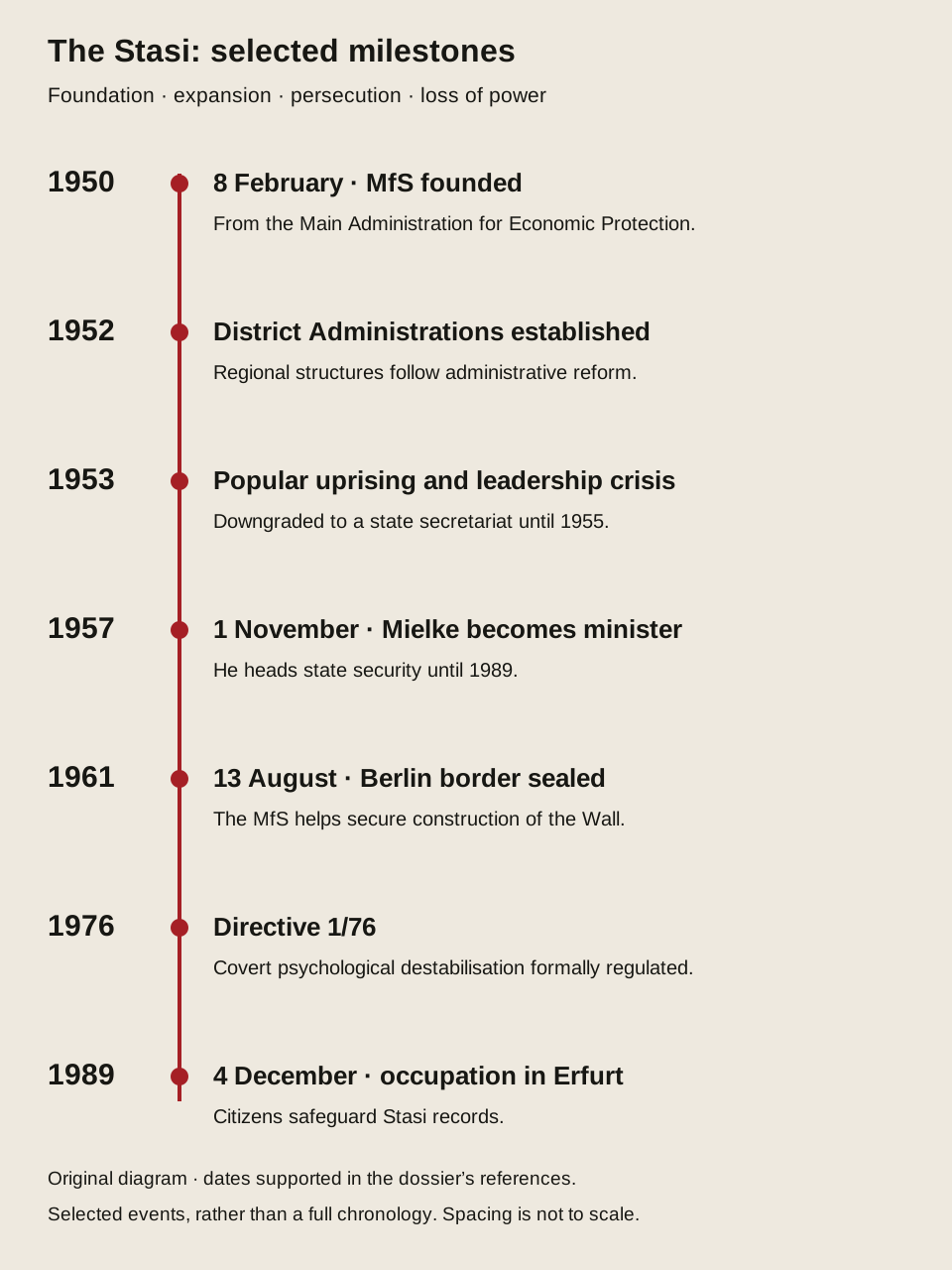
The popular uprising of 17 June 1953 shook SED rule. Klaus Bästlein describes how the party leadership accused state security of failing to give timely warning. Minister Wilhelm Zaisser lost his post; Ernst Wollweber took over. For two years, state security was downgraded to a state secretariat within the Interior Ministry. It regained ministry status at the end of 1955.[4]
These organisational changes did not end political persecution. Bästlein describes further arrests and political trials after 1953, as well as alternating periods of limited relaxation and renewed repression. On 1 November 1957, Erich Mielke became Minister for State Security. He shaped the organisation until 1989.[4]
From social protest to political demands
The uprising had a background. In the MfS encyclopaedia, Christian Halbrock and Ilko-Sascha Kowalczuk describe how the accelerated construction of socialism from 1952 intensified economic difficulties and political repression. Increased work quotas effectively meant wage cuts. The protests went beyond workplace demands: in many places, people demanded freedom, democracy and reunification. Soviet troops suppressed the uprising.[71]
Erfurt and Sömmerda: protest continued after 17 June
In Erfurt, several hundred construction workers went on strike on 17 June and demanded the government’s resignation. At the Funkwerk plant, employees combined demands for the right to strike and lower work quotas with criticism of the government. The next day, workers at the Pels factory in Erfurt-Nord went on strike; Soviet soldiers deployed outside the factory. On 19 June, tram drivers stopped work to demand the release of arrested colleagues.[70]
The Federal Archives gives a total of 80 people arrested in Erfurt and describes significant MfS involvement in the arrests. Most were reportedly released after days or weeks without a judgment. This figure refers to Erfurt and is not used here as a figure for the whole district.[70]
In Sömmerda, employees of the Rheinmetall factory took to the streets. Alongside economic demands, demonstrators called for free elections throughout Germany and a change of government. The state of emergency was followed by arrests and long prison sentences.[70]
State security’s role in suppressing the uprising
The SED leadership’s accusation that state security had failed explains its actual role only partly. Halbrock and Kowalczuk describe both inadequate preparation and swift repressive action. State security, the police and the judiciary worked together under the direction of the party and the Soviet occupation power. Arrests and political criminal proceedings continued after the days of the uprising.[71]
Evidence of an arrest does not answer every question about an individual case. The arresting authority, specific place of detention, duration of imprisonment and any court decision still need to be established. The regional account therefore does not permit all arrests in Erfurt to be attributed indiscriminately to Andreasstraße.
Erfurt as a model for later operational command groups
Torsten Diedrich and Hans-Hermann Hertle show how, after the uprising, the SED directed its security bodies towards combating internal unrest. The police, factory security and combat groups were strengthened; alert and operational plans were intended to enable faster intervention. This expansion therefore concerned several institutions.[72]
One detail is particularly revealing for Erfurt: the authors describe the Politburo decision of 26 January 1954, which provided for regional operational command groups modelled on a body formed in Erfurt on 17 June 1953. Party leadership, the People’s Police, state security and the Barracked People’s Police were to work together within them.[72] Regional history thus leads to the question of how the safeguarding of political power was organised across institutional boundaries.
1961: sealing the border and persecuting criticism
By sealing the Berlin border on 13 August 1961 and subsequently building the Wall, the East German leadership intensified the border regime. State security was involved in its preparation and enforcement. A source account from the Federal Archives shows its tasks: securing construction, identifying people intending to escape, persecuting criticism and compiling reactions from East and West for the leadership.[5]
The Berlin Wall and the border between East and West Germany were geographically distinct parts of this regime. The MfS’s history therefore includes Berlin as well as surveillance in border districts and the interior. For Erfurt, this leads to regional border security and the monitoring of transport routes.
The 1960s: surveillance as a permanent task
After the Wall was built, further MfS expansion was not a foregone conclusion. Jens Gieseke describes proposals to reduce its size; from 1964, however, Mielke imposed a comprehensive remit. Businesses, administrative bodies, schools and universities were increasingly penetrated by unofficial collaborators. Safeguarding party rule was to reach ever deeper into everyday social life.[1]
A key to understanding this development is the term “political-ideological subversion”, abbreviated PiD in German. Roger Engelmann explains that state security used it to describe both Western influences and dissenting thought within the GDR. Criticism arising within the country was attributed, as a matter of principle, to outside influence. People expressing different political views publicly could thereby become targets of intelligence surveillance.[45]
This designation describes the apparatus’s perspective. It is not evidence that a critical person was actually directed by the West. This distinction is crucial when reading Stasi files: a report may preserve an opinion or action while also distorting it through political interpretation. Observation, assessment and verifiable facts must therefore be distinguished.
1968: protest against the invasion — including in Erfurt
The Prague Spring raised hopes of political change in East Germany too. Protests followed the military intervention in Czechoslovakia on 21 August 1968. Bernd Gehrke describes leaflets, wall inscriptions, spoken dissent and symbolic expressions of solidarity. Many actions remained local and were undertaken at considerable risk by individuals or small groups.[46]
Gehrke identifies a specific event in Erfurt: on the day after the invasion, around 150 to 250 young people gathered at the Angereck and tried to discuss it with passers-by. According to his account, 36 young people were arrested. This public dissent therefore also forms part of the local history of political persecution. However, the article alone does not establish which of those arrested were subsequently imprisoned in Andreasstraße or how their individual proceedings developed.[46]
The 1970s: more contacts, intensified control
Détente changed the conditions of surveillance. Gieseke describes increasing contacts between East and West and the presence of Western press correspondents in East Germany. State security tried to keep these new connections under control.[1] The regional overview of transit surveillance shows how this development affected Erfurt District.
Expansion is particularly clear in the cultural sphere. Matthias Braun explains how securing institutions developed into increasingly person-centred surveillance. Order 20/69 regulated the creation of specialised structures for culture and mass media in Main Department XX and the District Administrations. In the mid-1970s, the MfS expanded this apparatus considerably. Artists and writers were increasingly seen as potential political opponents.[47]
The 1975 Final Act of the Conference on Security and Cooperation in Europe did not lead state security to withdraw either. According to Braun, Mielke intensified surveillance in areas where he regarded Western contacts as particularly dangerous. At the same time, international attention to repression was to be avoided wherever possible. Covert influence consequently gained importance.[47]
The 1970s: persecution beyond visible criminal proceedings
“Zersetzung”, or psychological destabilisation, was a method of covert action against people and groups the MfS regarded as opponents. Directive 1/76 regulated such measures. In the MfS encyclopaedia, Thomas Auerbach and Ilko-Sascha Kowalczuk describe damage to reputations, deliberately engineered professional failures and the sowing of distrust within groups, among other methods. Such interventions were intended to unsettle and isolate people and make joint action harder.[6]
Those affected included independent peace, environmental and human rights groups, applicants for emigration and active Christians. The method could replace criminal proceedings when the leadership considered overtly political persecution inexpedient. This means neither that imprisonment disappeared nor that every professional or personal conflict was caused by the MfS. Attributing a specific measure requires its own evidence.[6]
1976: Wolf Biermann stripped of his citizenship
The singer-songwriter Wolf Biermann’s deprivation of citizenship publicly exposed the limits of permitted dissent. The Stasi Records Archive’s document publication describes a performance ban in place since 1965 and intensive surveillance of him. This included listening devices, mail interception, observation and unofficial collaborators. In November 1976, the leadership used his concert in Cologne as a reason to bar his return to East Germany. The possibility of depriving him of citizenship had been prepared years earlier.[48]
The event triggered protest even among well-known intellectuals previously considered close to the system. The example shows that criticism did not come only from declared opponents of the GDR. It also demonstrates the limits of state planning: removing a critic could provoke new public solidarity instead of ending the conflict.[48] Nevertheless, the experiences of prominent cultural figures do not provide a general yardstick for everyone persecuted. Braun stresses that public recognition and Western media attention affected the MfS’s ability to intervene; unknown individuals often had less protection.[47]
The 1980s: surveillance with limited effect
Walter Süß examines how state security acted against the civil rights movement in the late 1980s: short-term arrests, administrative penalty proceedings, informants and attempts to destabilise groups formed part of its repertoire. At the same time, people without the protection of a publicly known network could still risk pre-trial detention. Different forms of persecution existed alongside one another.[7]
However, extensive information gathering did not guarantee successful control. Süß documents internal assessments from August 1989 stating that suitable informants to influence opposition groups were lacking and that efforts achieved too little. Such reports show the apparatus’s limits; they do not allow the conclusion that its activities had become harmless to individuals.[7]
In autumn 1989, state security entered a crisis alongside SED rule. In December, citizens occupied its offices and initiated its dissolution. Reorganisation as the Office for National Security could not secure its survival. The chapter “Dissolution and access to records” examines what followed and the conflicts over the files.[1]
Regional focus
The Stasi in Erfurt: city, district and transport routes
More than one office in the city
The administrative reform of 1952 also changed state security’s organisation: the five regional state administrations became 14 District Administrations. With Berlin added later, there were 15. In important areas of work, the district apparatus reflected the central structure, although not every task had a separate regional counterpart. This “line principle” explains why, for example, central and district investigative bodies were connected professionally.[8]
For the territory of present-day Thuringia, the State Agency for Civic Education identifies the Erfurt, Gera and Suhl District Administrations, alongside separate structures associated with Wismut. “The Stasi in Erfurt” therefore does not mean state security throughout Thuringia. Similarly, the city of Erfurt must be distinguished from the larger Erfurt District.[9]
The District Administration formed the regional apparatus, while local offices enabled action on the ground. The account by the Stasi Records Archive in Erfurt describes comprehensive territorial coverage through offices in the local administrative areas. Asking about regional significance therefore takes us beyond well-known buildings: places of residence, workplaces and transport routes also belong to the field of investigation.[10]
1970: Operation “Confrontation” — Brandt and Stoph in Erfurt
On 19 March 1970, West German Chancellor Willy Brandt and East German Prime Minister Willi Stoph met in Erfurt. The State Agency describes state security’s extensive security effort, and nevertheless the crowd at the “Erfurter Hof” calling Brandt to the window and cheering him. The example shows that even prepared measures could not completely control spontaneous public reactions.[9]
State security’s work began long before the day of the visit. On 13 March 1970, Mielke’s Order 12/70 launched Operation “Confrontation”. The Federal Archives describes the MfS’s concern about unrest and Brandt’s growing reputation in East Germany. As early as 17 March, the Central Analysis and Information Group reported reactions to the forthcoming meeting to the inner circle of party and state leaders.[82]
Preparation: protecting the delegations and controlling the population
In Stasi in Thüringen, Elise Catrain describes an operation involving almost every department of the Erfurt District Administration. Alongside protecting the delegations, its aim was to prevent unwanted public reactions. Planned journeys to Erfurt were monitored; requests for leave could be refused and school examinations scheduled. The Stasi also intercepted letters and postcards addressed to Brandt.[83] Control thus extended beyond barriers at the station into businesses, schools and private communication.
The crowd disrupts the plan
On the day of the visit, people reached the square who were not among the selected participants deemed reliable. The MfS and the People’s Police could not prevent the calls for Brandt. The Federal Archives treats the Stasi’s later claim that West German journalists had organised the first calls for Brandt as an explanation unsupported by other sources or memoir literature.[82] Blaming an external opponent belongs to the authority’s perspective; it is not an established explanation for the crowd’s actions.
119 people “taken in”: what the figure means
The ZAIG’s final report of 15 April 1970 gives a total of 119 instances of people being “taken in”. Its breakdown includes measures before Brandt’s arrival and three cases in Weimar. The figure therefore concerns the operation and its temporal and geographical context.[84] It means neither 119 convictions nor 119 documented cases of imprisonment in Andreasstraße. Attribution to particular prisons and individual proceedings requires additional evidence.
Afterwards: observation does not end with the visit
According to Catrain, for weeks afterwards the MfS tried to identify participants from its own photographs and West German newspaper and television images.[83] At the same time, the published final report presented the security measures as largely effective and described coordination with party and state bodies and the SED District Leadership.[84] The event thus opens up several levels: public action, immediate repression, subsequent investigation and the apparatus’s justification of its actions to its leadership.
The border and transit routes
Regional tasks also included border security and transit surveillance. The Federal Archives describes how, after the Transit Agreement came into force in 1972, rest areas in the district became meeting points between East German citizens and people from the West. State security monitored the routes intensively. At the border, its control began in the hinterland, particularly in the five-kilometre-wide restricted zone.[10]
The connection with the history of imprisonment is a research question: how did observations become investigations, and which offices were involved? In my own case, the published report and judgment provide specific clues. Other cases and regional procedures must be reconstructed independently. The following sections on Andreasstraße therefore begin with documented responsibilities and move from there to the individual person.
Pre-trial detention · Erfurt
Andreasstraße: pre-trial detention within the Stasi’s apparatus of power
A place of detention in the city centre
Andreasstraße is immediately beside Erfurt’s Cathedral Square. According to Stiftung Ettersberg, the Ministry for State Security’s District Administration and its remand prison were located there from 1952. Political persecution therefore had a physical presence in the city: offices and the prison stood close together.[11]
However, the prison was not exclusively a Stasi prison. Johannes Beleites describes its joint use by state security and the People’s Police; the MfS had cells on the first and second floors. This distinction is essential: the history of the building and the history of MfS pre-trial detention are connected, but they are not identical.[12]
Who investigated — and who organised detention?
Understanding detention requires distinguishing two areas of responsibility. Department IX of the Erfurt District Administration was the investigative body. The Federal Archives lists tasks including criminal investigations into offences against the state and other crimes with a background the MfS considered relevant to state security. The surviving holdings also include records concerning the handling of so-called “unlawful departure from the GDR”.[13]
By contrast, Department XIV was responsible for the District Administration’s pre-trial detention and penal custody, and for managing and securing the prison. The Erfurt archive holdings include, for example, records of arrest warrants, prisoner appearances, visits, medical examinations and prisoners’ personal belongings. These are different areas of prison administration; their presence in the archive does not establish that every document survives for every prisoner.[14]
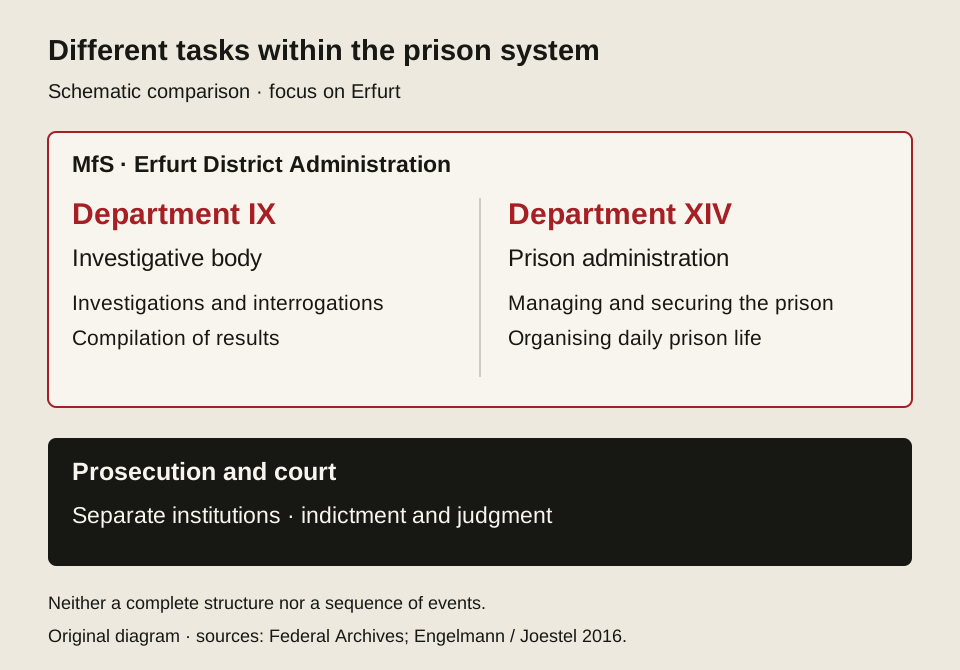
The MfS’s investigative bodies also had links with the judiciary. Roger Engelmann and Frank Joestel describe Main Department IX in Berlin and the District Administrations’ professionally subordinate Departments IX as the “investigative line”. Their duties included interrogations and compiling investigation results; the final report formed a basis for the subsequent indictment. Distinguishing state security, the prosecution and the court therefore remains necessary even when examining how they worked together.[15]
Isolation and a changing prison system
MfS pre-trial detention did not remain unchanged for four decades. Engelmann and Joestel show changes in interrogations, evidence gathering and contact with defence lawyers. At the same time, prisoners’ extensive isolation remained a considerable means of pressure. For the late 1980s, they describe easier access to lawyers, but also the interception of those conversations and the use of cell informants.[15]
This research describes MfS investigative practice as a whole. Whether a particular measure was used against me or another individual in Erfurt requires separate evidence. A general account replaces neither examination of personal files nor a conversation about memories.
Physical capacity also imposed limits on prison administration. Beleites reports that, in 1989, the Erfurt prison no longer met the District Administration’s needs, and MfS prisoners were additionally held in Interior Ministry remand prisons in Weimar and Gotha. This shows that examining Erfurt’s prison history must also extend beyond the building in Andreasstraße.[12]
Pre-trial detention in Andreasstraße: prison conditions and daily life
Daily prison life means more than a cell’s furnishings. It also includes waiting for the next interrogation, dependence on permissions and separation from familiar people. For Andreasstraße, the following account connects local memories and documents with research into MfS pre-trial detention. General findings are expressly identified as such.
Arrival and admission: control over one’s own body
Karl Wilhelm Fricke describes body searches on admission to MfS pre-trial detention, changing into prison clothing and being addressed by a number. The number was intended to prevent fellow prisoners in neighbouring cells from learning a person’s name. His account examines the prison system as a whole; it does not establish the precise sequence of my admission in Erfurt.[28]
The Erfurt holdings overview lists arrest registers, medical examinations and records of money and personal belongings, among other material. Such records can help reconstruct individual stages of admission. A medical examination recorded in a file says nothing by itself about the quality of care or how the person concerned experienced admission.[14]
Cell and isolation: imprisoned together, cut off from outside
Stiftung Ettersberg describes interrogations, isolation and uncertainty as defining features of daily prison life in Erfurt. On its website, Harald Ipolt, imprisoned in Andreasstraße from June to December 1978, recalls sharing a cell with three other prisoners. He describes the absence of work and how slowly time passed. His faith and the bells of the nearby cathedral gave him strength.[27]
This account shows that isolation from the outside world could exist even in shared accommodation. “Isolation” and “a single cell” describe different circumstances. Ipolt’s recollection documents his period of imprisonment; it describes neither every Erfurt cell nor automatically my conditions in 1989.
Exercise and activity subject to permission
For the late 1980s, Johannes Beleites describes outdoor exercise in the MfS prison system taking place in small, separated yards. Contact with inmates of other cells was prohibited; interrogations could take priority. Reading also required permission from the investigative department. These general findings explain why even movement and activity depended on the apparatus’s decisions.[12]
For Erfurt, the foundation shows historical photographs of the exercise yard from 1989 and guards patrolling above it from 1990. The images document local physical conditions. They provide neither a complete daily timetable nor information about how often a particular prisoner was taken outside.[27]
Interrogation and waiting: the pressure of the investigation
Fricke describes the deliberate preparation of interrogations and the use of psychological pressure. He also points out that interrogation records were worded by the investigators. The written question-and-answer format must therefore not be read without examination as a verbatim account of a conversation. His study covers different decades; individual methods require examination by period and case.[28]
For the account of my case, this means that a record can document which statement the authority preserved. My recollection describes how I experienced the situation. If the two differ, that difference must remain visible. It must not be concealed by an apparently seamless narrative.
Visits and contact with lawyers: a limited connection with the outside
Beleites describes family visits requiring approval and being monitored. Contact with lawyers was also controlled; in the late 1980s, conversations were often secretly intercepted. These are findings about the MfS prison system as a whole, rather than a documented description of a conversation in my case.[12]
My case: my mother’s planned visit
On this website, I publish my mother Rosemarie Obst’s visiting permit and her handwritten list of items to bring. The permit records the next visit as 11 April 1989 at 13:30. In my personal account, I explain that the visit was cancelled because my trial took place that day. My mother could be present in the courtroom’s public gallery; according to my recollection, the planned personal visit did not take place.[29]
Document and memory complement one another here without establishing the same thing: the permit records the planned appointment. The account of the cancelled visit and its significance comes from my personal narrative. The published documents reveal the planning of contact with a relative; a separate record would need to be examined to establish the precise official decision to cancel it.
View the visiting permit, the list of items and my recollection
One place of detention, different lives
Andreasstraße connects people persecuted for different reasons. Their life stories complement examination of the authorities and their methods. Two further examples show how pre-trial detention was linked to the wish to emigrate and its consequences for families. They stand alongside Harald Ipolt’s prison account, discussed above, and my personal documentation.
1983/84: Lorenz Pagés — pre-trial detention and release in exchange for payment
Stiftung Ettersberg describes Erfurt-born Lorenz Pagés as a political prisoner in 1983/84. He spent four months in Stasi pre-trial detention in Andreasstraße; his imprisonment lasted almost a year in total. The foundation gives planning and preparing an escape under Section 213 as the grounds for persecution. West Germany subsequently secured his release through payment.[11]
Pre-trial detention in Erfurt and the total period of imprisonment must be distinguished here. The memorial’s account does not replace examination of the judgment and complete prison files.
1984: the Höfelmayr family — persecuted together, separated in prison
Elise Catrain describes the arrest of the Höfelmayr family from Eisenach on 29 March 1984: Hannelore and Martin and their two children were arrested on suspicion of preparing an escape. After separate interrogations in Eisenach, all four were taken to Andreasstraße. The family had previously applied to emigrate.[85]
The study distinguishes statements in files from recollection: an MfS note attributed an admission of escape intentions to their daughter Ina; Ina Jaekel disputes this account. Pre-trial detention separated the relatives. Only in court on 11 July 1984 did they see one another again, without being allowed to speak.[85]
Penal imprisonment followed at the end of July. Mother and daughter were taken to Hoheneck. Almost six months after their arrest, the family’s release was secured through payment, and they were sent to Gießen.[85] Here too, pre-trial detention in Erfurt must be distinguished from later places of imprisonment.
1988/89: Silke Wilden — imprisonment and separation from her daughter
Stiftung Ettersberg’s 2021/2022 annual report presents Silke Wilden’s life story. After applying to emigrate in 1985, she lost her job as a nursery teacher; further applications were unsuccessful. In 1988, she tried to escape through Czechoslovakia to Austria. She was arrested, taken to Andreasstraße and sentenced to one year and two months in prison. Pre-trial detention was followed by imprisonment in Hohenleuben. After seven months in total, her release was secured through payment.[73]
Her daughter initially remained in East Germany. In an interview with Jochen Voit, Wilden describes the strain of this separation. She could collect the child only in June 1989. The biographical account also reports that she had been forbidden to write to her daughter from prison.[73] Her case thus extends beyond the prison: political persecution intruded into relationships and the lives of relatives.
What these life stories establish
These examples come from the memorial’s publications, including an eyewitness interview. They reveal individual experiences and identify local connections. This section is not based on an independent examination of these people’s complete prison files. Similarities can be compared; differences in period, cause and course of imprisonment remain visible. My own story is part of this local history while retaining its individual course.
My case: personal experience and bureaucratic traces
In my personal chronology on this website, I describe my arrest on 14 February 1989 and pre-trial detention in Andreasstraße. A published daily report by the MfS’s Central Coordination Group dated 15 February 1989 records my case the very next day. It gives a planned route through Czechoslovakia and Austria to West Germany, and the criminal investigation opened against me under Section 213 of the East German Criminal Code.[16]
The report connects the Erfurt case with central MfS reporting. As an official source, it reflects state security’s perspective; it does not explain the complete investigation or my experience of imprisonment.
The first page of the judgment of 11 April 1989 published here documents my conviction by Erfurt-Mitte Local Court and sentence of one year and two months for “preparation for an unlawful border crossing” and “public denigration”. In the accompanying personal account, I also describe my later transfer to Cottbus and Karl-Marx-Stadt. Pre-trial detention in Erfurt and the entire period of imprisonment until 20 October 1989 are therefore considered separately.[17]
From a place of detention to safeguarding the files
On 4 December 1989, Erfurt citizens occupied the local Stasi headquarters and its prison. Stiftung Ettersberg describes this as the first occupation of a Stasi office in East Germany and a decisive step towards saving the files from destruction. Andreasstraße thus represents both persecution and resistance to the apparatus of power. The chapter “Erfurt 1989 and the history of remembrance” explains this turning point and its consequences.[11]
Today’s memorial and education centre collects life stories and is compiling an overview of political prisoners. It expressly distinguishes Stasi pre-trial detention from political imprisonment in People’s Police custody on the lower ground floor. This distinction also remains central to further work on this dossier.[18]
Organisation and personnel
Who sustained the apparatus — and how did it reach everyday life?
The Stasi comprised different offices and activities. An employee might acquire information, analyse reports, direct informants or secure prison operations. Distinguishing these functions helps establish responsibilities. Regional history therefore also needs more than the names of senior officers.
Full-time employees: the personnel base
Jens Gieseke gives a total of 91,015 full-time employees on 31 October 1989. This figure describes the apparatus at a particular moment; it is not a total of everyone who worked there during the MfS’s existence. Personnel grew particularly rapidly between 1968 and 1982. From 1983, the crisis in East Germany’s public finances limited further growth rates.[19]
Most full-time employees served under military employment arrangements. Political reliability and separation from the West played a central role in selection. Personal contacts in the West were forbidden for employees and their immediate families. Professional knowledge gained importance as the organisation developed. Gieseke also describes preferential recruitment from families of the socialist service class from the 1960s and 1970s onwards.[19]
State security can thus be examined as a professional world with its own bonds and opportunities for advancement. This interpretation explains the conditions for employment. It does not yet answer what a particular person did or which decisions they were responsible for.
Training: professional knowledge in the service of political persecution
State security also trained its employees in its own institutions. Günter Förster describes the school in Potsdam-Eiche, established in 1951, which received higher education status in July 1965. The MfS’s College of Law, abbreviated JHS, combined training and research with the intelligence service’s tasks. In 1989, its fields of study and research included Marxism-Leninism, specialised operational disciplines and law.[74]
The name can be misleading. Förster stresses that the course did not provide comprehensive training for work as a judge or lawyer. Intelligence theory and practice were its main focus. Practical training included working with unofficial collaborators and writing reports of meetings.[74] Training therefore led directly to activities used to acquire information from other people’s personal circles.
The description of Förster’s research characterises the college as an intelligence institution with a pronounced ideological orientation.[75] Historical examination must therefore consider professional knowledge, political instruction and perceptions of supposed opponents together. However, an academic qualification does not establish which decisions an employee later made.
Erfurt’s leadership: Josef Schwarz and the District Administration
A specific regional biography connects this training with a leadership position. According to Jens Gieseke’s biographical entry, Josef Schwarz joined the MfS in 1955. From 1962 to 1968, he undertook distance learning at its college; he received a doctorate there in 1972. After a senior role in Schwerin, he became head of the Erfurt District Administration in 1982 and a major general in 1983. He was discharged in 1990.[76]
The head coordinated the District Administration and its local offices. The Erfurt holdings overview lists organisational and staffing plans, leadership meeting minutes, annual plans, reports and situation assessments, among other material.[77] These documents offer starting points for examining the connection between instructions, regional planning and local implementation.
Holding a leadership role and making a decision in an individual case require separate evidence. The biography shows who led the Erfurt apparatus in the 1980s. By itself, it establishes neither a personal instruction in my case nor participation in a particular interrogation. The relevant case files and records of decisions would need to be examined. The duties of Departments IX and XIV, explained in the chapter on pre-trial detention, remain part of this regional structure.
Unofficial collaborators: information from social relationships
Unofficial collaborators, abbreviated IM in German, secretly acquired information from their social surroundings. Helmut Müller-Enbergs describes their activity as a central instrument of state security: they reported on opinions, contacts and political activities, and could also influence individuals or developments. The MfS deliberately deployed them in areas it considered vulnerable or politically suspicious.[20]
Müller-Enbergs gives approximately 189,000 IM for 1989 and describes considerable regional differences in surveillance density. This is a historical estimate for a defined period and must not be used as an exact Erfurt personnel figure. Nor does it mean that all informants had the same task or influence.[20]
Cooperation must be examined through its duration, assignments and reports. A cover name alone does not explain actions. For those affected, confidential relationships could unknowingly become Stasi information sources.
Recruitment: preparation, interests and pressure
Helmut Müller-Enbergs explains that the MfS was supposed to prepare “recruitment” and obtain approval from superior officers. A proposal recorded the candidate, objective, intended approach to the conversation and security arrangements. Further contacts often preceded the actual recruitment discussion. The authority distinguished political and ideological convictions, personal needs, and so-called “efforts to obtain reassurance and make amends”; the last category could involve pressure.[94]
These terms initially describe the MfS’s perspective. They do not conclusively explain an individual’s motives. In his broader account, Müller-Enbergs identifies predominantly idealistic motives, less frequently material ones, and blackmail less frequently still.[20] This permits neither ruling out a specific situation of pressure nor assuming one in every instance of cooperation.
Commitment and actual activity
According to Müller-Enbergs, a declaration of willingness completed recruitment. Usually handwritten, it included a reference to state security, secrecy, a cover name and a signature. Exceptionally, it could be given orally.[95] The absence of a written declaration therefore does not by itself answer whether cooperation occurred. Conversely, a surviving declaration does not describe its entire subsequent course.
Activities involved different tasks. Alongside gathering information and exercising influence, there was also logistical support. The IMK category, used from 1968 to 1989, designated, for example, people who provided rooms for secret meetings, cover addresses or cover telephone numbers.[97] An account of someone’s actions must therefore identify the specific support or reporting documented.
Personnel files, working files and reports of meetings
Under Directives 1/68 and 1/79, an IM case normally consisted of a personnel file, Part I, and a working file, Part II. The personnel file was often initially maintained as an IM preliminary case and contained records about the person and their commitment. The working file was supposed to contain written reports, transcripts of audio recordings and meeting reports by the handling officer or supervising IM. A combined file was provided for IMK.[96]
When examining a source, it is therefore crucial to establish who wrote it: the informant or someone summarising a meeting. An assignment, a report, the office’s assessment and the resulting measure are different pieces of evidence. A plan shows an intention; establishing whether it was implemented and what consequences it had requires further records. The file structure helps with this examination but does not guarantee complete survival of the records.
For Erfurt’s history, this question can be pursued, for example, through the operations in the West at Umformtechnik Erfurt already described and the Analysis and Control Group’s supervision of IM deployment. Specific people and actions are attributed here only with separate evidence. My own prison history provides no basis for speculation about people around me.
Local offices: access to local institutions
Roland Wiedmann describes the local offices as units with territorial responsibility. They monitored the economy, transport, administration, healthcare, culture and education, among other areas. Their tasks included security checks, involvement in travel permissions, and reports on public attitudes and developing situations. They worked with the People’s Police, local councils and other institutions, and maintained links with the SED’s local leaderships.[21]
Local responsibility alone does not establish a measure in a particular business or school. Local files or other verifiable case evidence are required.
Erfurt’s service units: specialised tasks and local responsibility
The structure described by the Federal Archives for 1989 shows the different levels. The head of the District Administration answered directly to the Minister for State Security. Four deputies oversaw two operational areas, operational technology and support, and intelligence. Erfurt had 13 local offices, subordinate to the District Administration’s head.[78] The District Administration was thus responsible for an area extending far beyond the city of Erfurt.
The specialist departments followed the “line principle”: tasks of the Berlin headquarters generally had a counterpart at district level. In Erfurt, Department XVIII handled the national economy; Department XX covered the state apparatus, culture and churches, among other fields. Department M monitored mail; Department VIII carried out observation and investigation. Department XV was responsible for intelligence. In the 1989 structure, Investigative Department IX and Department XIV, responsible for pre-trial detention and penal custody, answered directly to the head.[78]
Local history therefore requires two questions to be brought together: which office had territorial responsibility, and which specialist department handled the relevant task? This overview describes the position in 1989. Organisational changes in earlier decades require separate examination.
Analysis and control: how information reached the leadership
Erfurt’s Analysis and Control Group, abbreviated AKG, analysed information obtained through intelligence work. According to the Federal Archives holdings overview, it prepared information for the District Administration’s leadership, the SED District Leadership and the MfS in Berlin. It also prepared service conferences and regulations and supervised other service units’ work.[79] Information from the region was thus processed for different levels of leadership.
The surviving holdings include annual reports and work plans, reports on public attitudes and opinions, and records on the political situation in 1989. They also document supervision of local offices and departments in deploying unofficial collaborators.[79] This description identifies possible research approaches. It does not replace examination of individual files.
The circumstances in which such reports were produced remain crucial when reading them. A summary of “public attitudes” is not a representative population survey. It was selected and formulated within a political surveillance apparatus. Its occasion, author, underlying reports and recipients must therefore be examined. Only then can we assess more precisely how observations became a situation assessment or a decision.
Organising and retrieving information
Card indexes, registration and files: how the Stasi managed its knowledge
Collected information had to be retrieved and attributed within the apparatus. Departments XII were among those responsible. They maintained card indexes, registered cases, archived records and supplied information at operational service units’ request. Such departments existed in Berlin and the District Administrations. Local offices did not archive their holdings independently.[90]
F 16 and F 22: two connected indexes
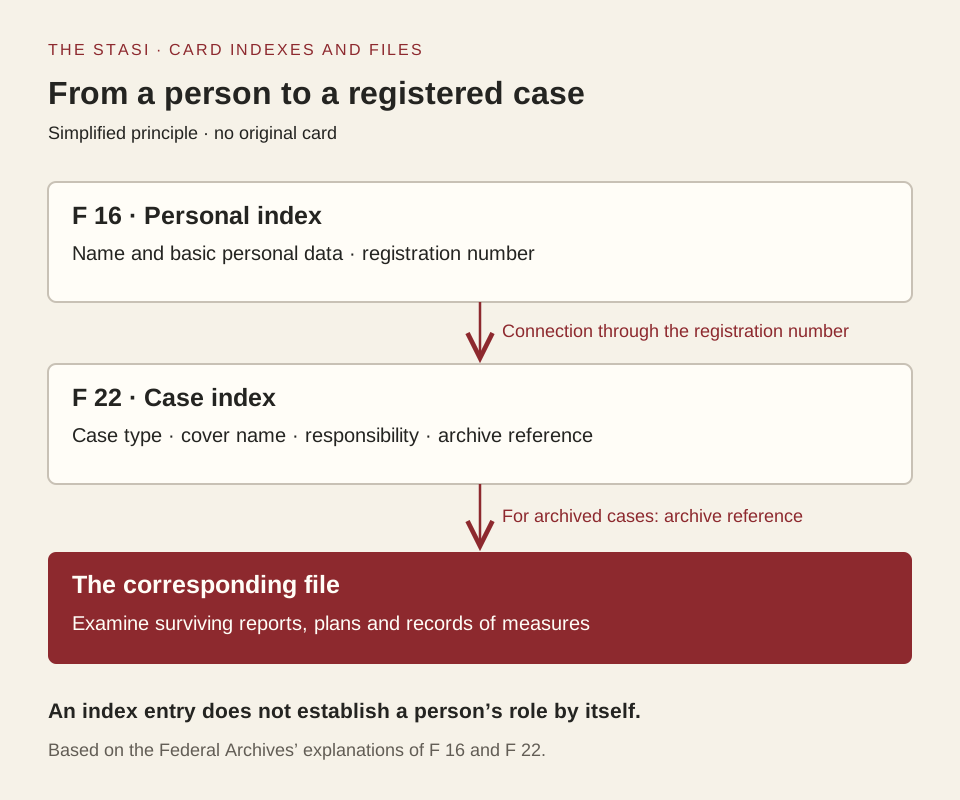
Doreen Hartwich describes F 16 as a personal index. It contained details such as names, dates of birth, workplace, registration date and responsible service unit. The registration number connected the entry to the F 22 case index.[91] The card thus helped identify a person’s record, but did not replace the corresponding documents.
F 22 recorded the case type, cover names, responsible service unit and employee, but not the real names of the registered people. The two indexes were kept in separate locations to preserve internal MfS secrecy. An archive reference could point to the archived case. If it was absent, Hartwich explains, the MfS had not yet archived the case.[92] The absence of this entry is therefore not itself evidence of later file destruction.
Erfurt Department XII and its surviving records
For Erfurt, the Federal Archives lists registration and checks of people and objects, card indexes, registration, archiving and supplying information. Surviving material includes work information, plans, transfer records and statistics on OV, OPK and IM cases. Some holdings arrived at the archive unordered and as loose sheets; subject-related records were initially listed in bundles following a preliminary review.[93] Present-day cataloguing must therefore be distinguished from the original filing system.
What an index entry establishes — and what still needs examination
Department XII registered different categories, including investigation cases, Operational Cases, Operational Person Checks and IM cases.[90] A name in an index therefore does not by itself mean cooperation with the Stasi. The registration category, connections and surviving files must be examined. Official classification of a person and a specifically documented action must also be distinguished.
A consistent sequence of questions helps when reading: whom does the entry concern? Which case type is recorded? Who managed the case, and when? Which related documents survive? Only their content permits further examination of the claims and measures at the time. The losses of 1989/1990 can limit this reconstruction. My personal documentation includes the chapter How the Stasi managed its information.
Surveillance and persecution
Acquiring information, observing people, planning measures
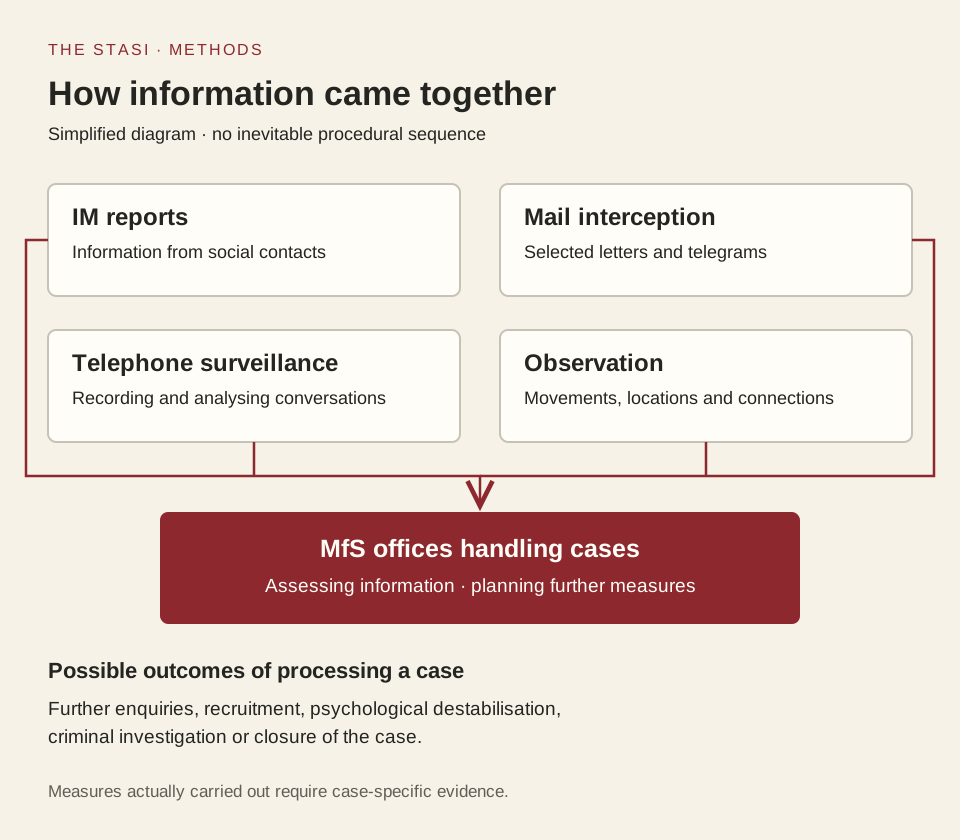
MfS methods intruded into personal relationships and private communication. They complemented one another: a lead could trigger further enquiries; technical recordings could supplement reports. Which combination was actually used requires separate examination in every case.
Mail interception: letters as an information source
Departments M were responsible for monitoring letters and telegrams. Wiedmann describes covert monitoring points in central post offices: items were selected by address or conspicuous external features, opened and often copied. Usually, they were resealed and forwarded; some were retained. Monitoring instructions could concern individuals, but also larger geographical or social groups.[22]
Passing through a monitoring point does not mean that every letter was opened and read. Selection, instructions and surviving results must be distinguished when reconstructing this history. Surveillance could also capture uninvolved correspondents whose names and messages entered the files.
Telephone surveillance: technical recording and analysis
Angela Schmole describes telephone surveillance as a Department 26 responsibility. Interception was installed at Deutsche Post switching facilities, and conversations were recorded at MfS bases. The procedure changed: recording equipment followed handwritten records; from 1978, devices enabled automatic recording. Depending on the assignment, conversations were analysed in full or in extracts.[23]
Selection and analysis determined reports’ content. A conversation summary must be examined to establish who wrote it and whether it reflects the complete recording or only an extract.
Observation: recording movements and contacts
According to Schmole, covert observation was generally commissioned by other operational units and carried out by full-time employees of operational line VIII. Selected people’s locations, connections, workplaces and habits were observed. Results could feed into person checks, Operational Cases or security checks.[24]
An observation report can document contacts and movements, but does not itself explain people’s intentions. Political assessments within it remain MfS assessments.
The Operational Case: organised persecution
Christian Halbrock and Ilko-Sascha Kowalczuk describe the Operational Case, abbreviated OV, as a registered case against individuals or groups. It usually began with leads the MfS assessed as criminally relevant. Processing also included family, friends and colleagues. Action plans could provide for psychological destabilisation; possible outcomes included a criminal investigation, recruitment, further interventions or closure when suspicion was not confirmed.[25]
An OV must therefore be distinguished from a criminal investigation. The terms designate different forms of processing. The existence of an OV alone implies neither a conviction nor that every proposed measure was actually implemented.
Mail interception in Erfurt: private letters become official knowledge
Erfurt Department M was responsible for searching, monitoring and analysing letters, parcels and telegrams. The holdings overview also lists writing and address indexes and offices in main post offices.[80] This connection between postal traffic and information storage shows how ordinary communication could become the subject of intelligence work.
September 1989: criticism in private letters
In the regional study Stasi in Thüringen, Rüdiger Sielaff describes how Erfurt mail inspectors analysed reactions to political developments in mid-September 1989. Secretly opened letters included a doctor’s criticism of the East German crisis and demands for freedom of travel, the press and expression. A woman writing from Erfurt distanced herself from a public statement by Honecker. The study cites records from Erfurt Department M.[81]
The example connects private communication with political observation in autumn 1989. Personal thoughts were removed from their confidential context and assessed by state security. The account used here is based on the published study; an independent examination of the complete underlying file remains outstanding.
1986: Erfurt inspectors enrich themselves
Sielaff also describes a case discovered in late 1986: over several years, Erfurt mail inspectors had stolen money, stamps and goods for themselves. According to his account, 13 employees admitted criminal acts. A criminal investigation was opened against the principal offender; other consequences included dismissals and disciplinary measures.[81]
This case reveals an additional consequence of covert access to other people’s mail. It must be understood as a specific incident; it does not establish that every Erfurt mail inspector enriched themselves personally.
What survived of Erfurt’s mail interception
The Federal Archives describes only a small quantity of surviving subject-related records, but also an extensive M card index. The original arrangement of the information store had been destroyed. It was therefore reorganised alphabetically for searches relating to individuals.[80] A card retrievable today and a completely surviving surveillance case are thus different sources. Nor does the absence of evidence readily answer whether a particular item of mail was monitored at the time.
Regional evidence: Department 26 in Erfurt
The Federal Archives holdings overview for Erfurt Department 26 lists telephone and telex surveillance, room surveillance and technical observation as its tasks. Surviving material includes working documents, information on operational measures at bases and cable layout plans. This establishes technical surveillance as a regional area of work.[26]
The holdings overview provides access to records, rather than a complete history of their use. In particular, it does not establish that I was monitored in this way. Such a statement would require the relevant instructions, records or other case-specific evidence to be found and examined.
The technical holdings initially survived unordered and with cases mixed together. Following a preliminary review in 1997, the documents were catalogued.[26] A cable layout plan can explain technical conditions; it cannot establish by itself who was actually intercepted or what consequences followed. Technical records and reports concerning individuals must be considered together for that purpose.
Independence and collective action
Churches and independent groups: spaces of freedom under surveillance
The Stasi’s history also includes people and networks that escaped its control or opposed it. Churches offered independent structures, meeting spaces and opportunities for exchange. Groups emerged within and outside them to discuss social questions independently of state organisations. This history explains why surveillance and persecution could hinder collective action without preventing it altogether.
An independent sphere comes under pressure
Christian Halbrock and Ilko-Sascha Kowalczuk explain the SED’s suspicion of churches through their independence, religious message and ambition to shape society. In the 1950s, overt conflicts targeted church youth and student work, among other areas. Searches, confiscations and imprisonment also formed part of persecution. Later, obstructing events and exerting covert influence became more important.[61]
Methods included observation, unofficial collaborators and acquiring information from conversations. The MfS also tried to influence church decisions and recruit informants in leadership positions. According to the authors, however, comprehensive infiltration of the churches was not achieved.[61] Church membership, a conversation with a state office and unofficial cooperation are therefore different circumstances. Specific attributions require their own evidence.
Peace, the environment and human rights
Johannes Beleites describes how independent peace, environmental and human rights groups formed within and outside churches in the early 1980s. Initially, their exchange was limited; groups in different places often knew little about one another. Regional church gatherings during Luther Year in 1983 enabled new contacts and public discussions. Congregations also offered opportunities to reproduce independent publications and provide space for critical artists or young people.[62]
Church spaces thus mattered to people whose concerns extended beyond questions of faith. Beleites also describes the more regulated relationship between Protestant churches and the state following the meeting with Honecker in March 1978. Avoiding open confrontation did not end MfS activity.[62] Opportunities for protection and surveillance coexisted; the extent of a space of freedom must be examined locally.
Open Work: an Erfurt approach
For Thuringia, Katharina Lenski examines Open Work, or Offene Arbeit, as an alternative youth culture and a field of church work. She describes spaces for people whose clothing, music or way of life did not meet state expectations. Alongside personal exchange, activities developed around peace, human rights and the environment. For Erfurt, Lenski identifies the emergence of this youth work in 1979 and various groups organised around particular subjects.[63]
Open Work Erfurt itself describes its association in 1979 as a grassroots community or congregation searching for another form of church life.[64] This self-description reveals the community’s own understanding. It serves a different purpose from historical examination of its activities at the time and measures directed against it.
Lenski warns against idealising such places. Open Work was intertwined with the rest of society; differing interests, hierarchies and conflicts did not disappear within its spaces. She also describes tensions with state authorities and church leadership.[63] This does not diminish the history’s significance. Rather, it helps us understand participants’ opportunities and limitations more precisely.
Persecution and the limits of control
The growing appeal of church youth work, and later peace, environmental and human rights work, intensified the MfS’s suspicion. Halbrock and Kowalczuk describe surveillance of church meetings and the handling of contacts with West German congregations.[61] Measures used against individual groups must be reconstructed separately. The chapter on psychological destabilisation explains one method used; it does not yet establish a specific Erfurt case.
For local history, this section leads to the chapter on Erfurt in 1989 and the occupation of the District Administration. Participants acted from different experiences. Neither all Christians nor all members of independent groups pursued the same aims. My own prison case is likewise not connected here with group membership without personal or documentary evidence. Individual lives remain distinct while their social connections are examined.
Music, independence and state intervention
Youth culture: punk between spaces of freedom and persecution
Music, clothing and self-organised performances created independent forms of exchange. The history of state security therefore also requires asking how cultural independence came under political suspicion and what opportunities participants retained.
Who was allowed to perform publicly?
In a research discussion at the Stasi Records Archive, musicologist Florian Lipp explains that bands had to undergo a classification process to perform legally in public. A commission assessed their audition; classification formed the basis for a performance permit. Some groups refused this process and played in private or church spaces.[86] Cultural administration, organisers and state security had different functions. Controlling a performance was not exclusively an MfS matter.
Eisenach and Erfurt: the “Fanatischen Frisöre”
In Stasi in Thüringen, Stephanie Schlesier describes how the Eisenach local office opened the Operational Person Check “Friseur” against the band in early 1988. The Operational Case “Laien” followed in the summer. State security wanted to prevent critical performances and pressured church leaders. At its instigation, the local council imposed a performance ban; a permit was offered if certain lyrics were dropped.[87]
The musicians rejected the offer and nevertheless played at Erfurt’s Augustinian monastery. After a member left, the Stasi closed the OV in February 1989, but continued monitoring the drummer in the OPK “Schlagzeug”. In July, the band performed at Gotha’s Church of Reconciliation.[87] Closing a case therefore did not end observation in this instance.
Repression, incorporation and independent action
Lipp distinguishes stronger restrictions in the first half of the 1980s from later attempts to incorporate some bands into state cultural programmes. He also describes conflicts between institutions and continuing regulations.[86] This development therefore cannot be told as uniform treatment of all groups. The Eisenach example connects forms of intelligence processing with the spaces of freedom described in the church chapter. The research accounts used here do not replace a complete examination of individual band files.
Political control in everyday life
Schools, universities and businesses: interference in education and careers
Political persecution could affect people without their being arrested. A denied educational path, a blocked career or pressure at work could also intrude deeply into a life. Understanding these events requires considering state security alongside the other institutions involved. Which office collected information, who initiated a measure and who implemented it are different questions.
Information from familiar surroundings
Stefan Wolle describes how the MfS met its demand for information through secret informants and reports from the party, mass organisations and state offices. Critical remarks, church connections or contacts in the West could also enter this reporting. Consequences could affect training places, promotions and travel permissions. Specific measures were often implemented by schools, universities, businesses or party and youth organisations.[57]
Wolle also explains state security’s influence over personnel decisions and the covert engineering of professional failures for people regarded as dangerous.[57] However, this does not mean that every rejected application or professional setback was caused by the MfS. In an individual case, political instructions, decisions by the responsible institution and possible Stasi involvement must be reconstructed through separate evidence.
1988: school expulsions after public dissent
At the Carl von Ossietzky School in Berlin-Pankow, young people publicly criticised military parades and nationalist tendencies in 1988. On 30 September, one female and three male pupils were expelled. The Federal Archives describes pressure from the school leadership, the FDJ and parents’ representatives, alongside MfS observation. An unofficial collaborator reported on the young people’s texts and teachers’ opinions.[58]
The expulsions prompted public solidarity, particularly in Protestant congregations. State security then tried to prevent further publicly effective support and intimidate the young people and their parents.[58] The example shows cooperation between different institutions and its limits: disciplinary action could generate dissent and support. It is a Berlin case; comparable procedures in Erfurt require independent evidence.
Universities: surveillance and institutional cooperation
Rainer Eckert distinguishes surveillance of universities from individual lecturers’ and students’ cooperation with the MfS. Control concerned leisure time, Christian student communities and foreign relationships as well as teaching and research. State security recruited informants among professors, employees and students and tried to suppress opposition activity and intentions to emigrate.[59]
Alongside this, official cooperation existed with university leaderships, SED and FDJ structures and security officers. Eckert describes the provision of personnel and student files and influence over appointments to important positions. Universities also served the MfS as places for commissioned research and recruitment of future staff.[59] Institutional cooperation and individual unofficial collaboration must therefore be examined separately. University membership alone says nothing about a particular person’s activities.
Businesses: economic security and political surveillance
Economic surveillance covered industrial and agricultural enterprises as well as trade, finance and research. Reinhard Buthmann lists counter-espionage, protecting classified information, monitoring reports on economic plans and combating supposed or actual “economic sabotage” among its tasks. The responsible MfS offices worked systematically with the party and state institutions. From 1964, the central service unit was called Main Department XVIII.[60]
Its activity changed with economic structures and political priorities. Buthmann describes intensified security checks and monitoring requirements, later particularly for major technological projects and protecting classified information.[60] For Erfurt, the example of Umformtechnik Erfurt and Audi illustrates how economic cooperation could be connected with surveillance of employees and business partners.
Examining such interventions broadens the understanding of political persecution beyond prisons. It also helps explain why personal recollections, personnel records, school or business documents and MfS files can illuminate different parts of an event. Connecting these sources helps establish responsibilities more precisely.
Beyond East Germany
Foreign intelligence and operations in the West: information, influence and persecution
State security was both a political secret police force and an intelligence service. Its activities did not stop at East Germany’s borders. Gathering information abroad and persecuting people outside the country were part of its history. Distinguishing these tasks helps explain responsibilities; their connections become particularly visible in specific cases.
Main Directorate A and its predecessors
The MfS’s principal espionage unit was Main Directorate A, abbreviated HV A. Helmut Müller-Enbergs describes its emergence from the “Institute for Economic Research”, established in 1951. In 1953, the apparatus entered state security as Main Department XV; from 1956, it was called HV A. Markus Wolf headed it from 1952 to 1986. Its focus was West Germany and West Berlin, but its work extended further.[53]
Targets included political institutions, parties, the military, other intelligence services, and science and technology. The HV A had a separate sector for acquiring scientific and technical information. Its organisation was thus directed towards different kinds of knowledge and target institutions.[53]
What was espionage intended to achieve?
Müller-Enbergs explains the interests behind information gathering: the political leadership wanted to know Western intentions; industry and research were to benefit from developments elsewhere. Acquiring technical knowledge was intended to save domestic development costs and reduce the economic gap. There were also attempts to influence public opinion and political debates through deliberately disseminated information. Espionage thus also supported the political and economic aims of SED rule.[54]
However, a surviving document or successful acquisition of information does not establish comprehensive control of Western society. Müller-Enbergs points to ideological interpretation of the findings and distinguishes deep insight into individual areas from an ability to control West Germany.[54] Historical assessment must therefore examine assignments, information actually obtained, analysis and demonstrable effects separately.
Why operations in the West meant more than the HV A
Other MfS service units also operated in the West. Alongside the HV A and the District Administrations’ Departments XV that it directed, the Federal Archives overview lists radio intelligence and mail interception, among other activities. There was also action against critics of the regime, escape helpers and former East German citizens who had emigrated. The HV A was generally informed about such activities and occasionally involved.[55]
The boundary between foreign operations and internal persecution was therefore permeable. People who had left East Germany could remain targets of state security. At the same time, the MfS used travel and family contacts to recruit informants. The Federal Archives describes political convictions, material incentives and personal connections as starting points.[55] However, a Western contact alone does not establish cooperation. Specific records and actions must be examined.
An Erfurt example: business trips to Ingolstadt
In the 1980s, Umformtechnik Erfurt sold crank presses to Audi and Volkswagen. Erfurt employees travelled to Ingolstadt for these orders; Audi representatives came to Erfurt. According to the Federal Archives account, state security monitored negotiations and machine installation. Among the developers and fitters were unofficial collaborators who supplied information about the Audi plant, its employees and their own travelling colleagues.[56]
The article cites a 1985 assessment by Erfurt Department XVIII of an IM’s suitability for deployment in Ingolstadt and a 1986 surveillance instruction concerning Audi representatives in Erfurt. The service unit responsible for safeguarding the national economy was therefore involved.[56] The example shows how economic contacts, information gathering in the West and control of the state’s own travellers could intertwine. It describes a specific context and cannot be applied to every business trip.
A history with considerable gaps in surviving records
Research into the HV A faces particular difficulties with the files. The Federal Archives describes its self-managed dissolution and the extensive destruction of its records. Surviving espionage holdings are consequently relatively small.[55] Missing records are not evidence that an activity did not occur. Conversely, gaps must not be filled with assumed events. The chapter on dissolution and access to records explains why the survival of records is itself part of the history.
Freedom of movement and political persecution
Escape, emigration and criminal prosecution
The wish to leave East Germany could arise from very different experiences. Laura Wehr identifies political persecution, restricted career opportunities, concern for children, family reunification and the need for freedom. Such motives could combine. Choosing an emigration application or an escape route therefore always also tells us something about the possibilities a person still saw for themselves.[33]
Emigration applications and escape plans: different paths
An application for permanent emigration aimed to leave East Germany permanently with state permission. Wehr describes how increasing numbers chose this bureaucratic path from the mid-1970s onwards. Among other arguments, they invoked human rights and the Helsinki Final Act. At the same time, applying and persistently pressing for emigration could bring professional disadvantages, surveillance and criminal prosecution.[33]
By contrast, an escape plan aimed at leaving without the required state permission. East Germany prosecuted such plans under criminal law. Persecution could begin even before a person reached a border. The distinction remains important even when someone considered escape after being refused emigration: an application, an act of preparation, an escape attempt and a completed escape are different events.[36]
Administration as a means of preventing emigration
Alongside border barriers, Frank Wolff examines administrative obstacles. Emigration policy long rested on confidential regulations and instructions; decisions were scarcely transparent to applicants. Review by an administrative court was unavailable. Petitions and letters of appeal remained important ways of urging the authorities to reach a different decision.[34]
The relationship between international recognition and denied freedom of movement intensified the conflict. People wishing to emigrate used treaties and human rights commitments as arguments. Wolff describes how the East German leadership expanded the opportunity to apply around the turn of 1988/1989. However, this did not yet create a general right actually to leave. An application, its processing and permission must therefore be considered separately even in the GDR’s final phase.[34]
How the Stasi acted against people wishing to emigrate
Christian Halbrock and Ilko-Sascha Kowalczuk describe combating the emigration movement as an MfS priority from the 1970s. Order 6/77 of 18 March 1977 regulated measures and cooperation. This included central and district coordination and connections with Interior Ministry authorities and local administrative offices.[35]
The authors describe so-called “discouragement discussions”, intended to persuade people to abandon their wish to emigrate. Improvements in housing or an end to professional disadvantages could be offered. Others were threatened with criminal consequences or imprisoned, particularly if they exerted public pressure or contacted Western offices. Measures thus ranged from influence in daily life to pre-trial detention.[35]
Criminal prosecution even before crossing the border
Monika Tantzscher explains the development of criminal provisions. From 1957, departure without permission was prosecuted under the Passport Act; the 1968 Criminal Code contained the offence “unlawful border crossing” in Section 213. Preparation and attempts were also punishable. The 1979 revision increased the maximum sentence in serious cases to eight years. This maximum says nothing about the sentence imposed in an individual case.[36]
Historical interpretation requires establishing when proceedings took place, which act was alleged and which provision supported the conviction. The heading “Republikflucht”, or escape from the republic, alone does not answer these questions. Nor should the language of prosecution at the time become today’s description of those affected without examination.
Escape routes through other states and central coordination
Tantzscher shows that routes through Czechoslovakia, Hungary and Bulgaria were also used after the Wall was built. Security services agreed to cooperate in preventing escapes and returning arrested East German citizens. Travelling to another socialist country therefore did not yet provide protection against the East German apparatus.[36]
The Federal Archives holdings overview identifies the Central Coordination Group for Escape/Resettlement’s tasks: coordinating measures against emigration applicants, preventing and investigating escapes, and combating escape assistance organisations. Its tasks also included coordination with other security services. Surviving holdings contain records on requests to resettle as well as escape attempts and suspected cases.[37]
From investigation to judgment: different responsibilities
The chapter on responsibilities distinguishes the investigative body from prison administration. Criminal proceedings also involve the judiciary: Engelmann and Joestel explain that MfS investigative bodies conducted interrogations and summarised results in the final report. This formed a basis for the indictment. A court delivered the judgment. The separate functions must be identified to examine their cooperation and political responsibility.[15]
Prisoner release transactions: a way out of prison
The Erfurt prison stories have already described several people whose release was secured through payment. Behind the German term “Häftlingsfreikauf” lay a practice developed over years between the two German states. The Federal Archives describes the efforts supported by the West German government from 1963: release in exchange for material compensation was negotiated for people whose convictions were considered politically motivated in West Germany. The negotiations remained secret.[88]
Appointed lawyers, state offices and the Protestant and Catholic churches were involved. Family reunification and exchanges of agents were intertwined with these efforts, but cannot be equated with every individual prisoner release transaction.[88] For a life story, the agreement that actually led to release or emigration must therefore be established.
Who negotiated and organised release?
Jan Philipp Wölbern gives a figure of over 33,000 political prisoners released through payment between 1963 and 1989. West German offices collected names and transmitted lists through the lawyers Wolfgang Vogel and Jürgen Stange. Churches supported the process with deliveries of goods. On the East German side, the MfS acted on behalf of the SED leadership; Mielke assigned coordination to Heinz Volpert.[89]
Wölbern describes how, after agreement was reached, prosecutors applied to suspend sentences on probation on MfS instructions, and courts instructed accordingly approved. In the 1960s, some prisoners whose release had been secured were released within East Germany. A prisoner release transaction and resettlement were therefore not always the same event.[89]
Freedom, compensation and the judgment that remained in force
For the West German government, helping those persecuted was the priority. The SED leadership received economic compensation and could simultaneously remove opposition-minded people from East Germany. Wölbern thus shows the contrasting interests behind a shared practice.[89] The significance of regained freedom for an individual cannot be reduced to the states’ negotiating objectives.
Release from prison is initially an event; “Häftlingsfreikauf” here denotes the negotiated arrangement behind it. The suspension of a sentence described above did not overturn the judgment. Later rehabilitation must therefore be considered separately. In my case, annulment is documented by the decision of 21 April 1993.[69] I do not infer from these rehabilitation records alone that my own release was secured through payment.
My planned departure became a criminal case before it happened
The published report of 15 February 1989 records my arrest the previous day. It identifies the Bratislava area in Czechoslovakia, the intended route through Austria to West Germany, and 16 February as the planned departure date. I wanted to take my skilled worker’s certificate, which I was due to receive on 15 February. The entry also reports that the Erfurt District Administration had opened a criminal investigation under Section 213.[16]
By contrast, the first page of my judgment of 11 April 1989 records the judicial decision: the criminal division of Erfurt-Mitte Local Court sentenced me to one year and two months in prison for “preparation for an unlawful border crossing” and “public denigration”. Both charges appear in the judgment; the entire sentence must therefore not be attributed solely to preparing an escape without further examination.[17]
The report records the planned route and criminal investigation; the judgment records the later conviction. How leads were gathered, statements obtained and evidence assessed can be examined only with further case records.
My personal recollection supplements these official traces with what departure meant to me: the hope of deciding my own life and future. This perspective belongs to the history. It is identified as my experience and does not speak for everyone wishing to emigrate or held in prison.
Read my entry in the MfS report · View the judgment and personal account
Loss of power and addressing the past · Erfurt
Erfurt 1989 and the history of remembrance
Andreasstraße’s history does not end with the last political pre-trial detention. The site also belongs to the people who stripped the intelligence service of power, safeguarded records and later campaigned for a memorial. These steps had different aims and unfolded over years.
4 December 1989: citizens open the Stasi headquarters
The reconstruction by Peter Große, Barbara Sengewald and Matthias Sengewald describes several connected initiatives. Contacts from the group “Women for Change” helped mobilise people. Participants included Kerstin Schön, Gabi Stötzer, Elisabeth Kaufhold and Barbara Sengewald. The account shows how personal relationships and mutual trust enabled joint action.[30]
While a delegation negotiated with the head, Josef Schwarz, other citizens entered the building. Subsequent inspections led to archives and facilities for destroying files. In the boiler room, participants found partly burnt papers, torn records and empty folders. Their efforts to safeguard material also included electronic storage media. Access to the remand prison followed during the occupation.[30]
The same event from different perspectives
The collection combines memories with contemporary records. A telex from the office reproduced there described entry as forcibly imposed while also stating that blocked entrances and exits had rendered the district office incapable of acting. This is the perspective of the apparatus that had lost power. The source must be read as such; its language does not replace an independent assessment of events.[30]
After the occupation: citizens’ watch and supervision of dissolution
Eberhard Stein describes the subsequent steps as a longer process. Working groups were formed the day after the occupation. Their aims were to safeguard the files, examine previous MfS work and dissolve the district’s intelligence structure. A citizens’ committee comprising representatives of different initiatives and parties was established in the town hall. Citizens could also provide leads there about previously concealed facilities.[31]
Committee representatives maintained a citizens’ watch at entrances and inside the building. Former employees’ access was gradually restricted; rooms were sealed and records secured. Files from dissolved local offices were brought to Erfurt and initially stored in the neighbouring remand prison. Regional history therefore also includes safeguarding records from outside the city.[31]
Historically, three processes must be distinguished: occupation interrupted the office’s previous control over its premises. Subsequent supervision was intended to ensure dissolution and preservation of records. Opening the files later to those affected and to researchers required further decisions. A rescued file was therefore not yet a generally accessible file.
From continued prison use to a memorial
After German reunification, Andreasstraße initially remained a men’s prison. It closed only in 2002. During this period, the former Stasi detention floor on the second floor was not used and remained largely in its 1980s condition. Today, the surviving fabric of the building is itself part of the historical exhibition.[32]
As the site deteriorated, concern for its preservation grew. Former political prisoners and participants in the Peaceful Revolution organised tours, events and art exhibitions. Stiftung Ettersberg recognises, among others, Barbara Sengewald’s and Harald Ipolt’s commitment. In 2012, the Free State of Thuringia entrusted the foundation with responsibility; on 3 December 2012, it opened the memorial and education centre to the public.[32]
Many life stories at one shared place
For this dossier, my personal documentation is one route into Andreasstraße’s history. Alongside it stand other prisoners’ experiences, the citizens’ movement’s perspectives and scholarly examination of the apparatus. These testimonies complement one another without merging into a single experience. Understanding the site requires both the history of persecution and the history of its liberation and preservation.
Loss of power and addressing the past across East Germany
Dissolution and access to records: a transition won through struggle
Opening the Berlin Wall did not end state security that same evening. The apparatus initially continued, was reorganised and was to be partly replaced by new intelligence services. Its loss of power, organisational winding-up and decisions about files were connected but distinct processes.
From the MfS to the AfNS: attempted reform and demands for dissolution
Christian Booß describes how the Modrow government wanted to transform the existing apparatus into a domestic security service and an intelligence service. From 7 December 1989, however, the Central Round Table demanded dissolution of the Office for National Security, the MfS’s successor. On 14 December, the government declared the AfNS dissolved. Plans for new services nevertheless remained contested. Under pressure from protests, Modrow yielded on 12 January 1990: no new intelligence service was to be created before free elections.[38]
A dissolution decision was not yet its implementation. Employees had to be discharged, weapons secured, buildings handed over and records gathered. Understanding the process therefore requires considering political decisions alongside their practical implementation.
15 January 1990: Berlin headquarters under citizens’ control
While citizens’ committees were already active in the districts, comparable permanent supervision was missing from Berlin’s ministerial headquarters in early January. On 15 January, thousands responded to the New Forum’s call for a demonstration; people entered the grounds and parts of the building complex. Booß reconstructs several strands of action: public protests, Round Table negotiations and initiatives by regional citizens’ committees. These processes partly ran alongside one another.[38]
An event whose significance researchers assess differently
Historical assessment is disputed. Booß interprets 15 January as a success for the citizens’ movement despite the old apparatus retaining opportunities for influence. Klaus Bästlein, by contrast, stresses that the SED and state security retained control over important processes and enabled further destruction of files. These differing interpretations are identified here as research positions. Occupation alone establishes neither an immediate complete transfer of control nor an end to all destruction.[38] [39]
Citizens’ supervision and state winding-up
David Gill, then coordinator of the citizens’ committee in Normannenstraße, describes its supervisory role. Alongside it were state commissioners and the state dissolution committee established in February 1990. Citizens’ committees were not identical to these bodies. Gill describes personnel shortages, lack of specialist knowledge and conflicts over information and access. His account combines a participant’s recollection with a retrospective examination of the limits of supervision at the time.[40]
What was saved — and what was lost
The Federal Archives distinguishes destruction ordered by the Stasi in autumn 1989 from further losses in the first half of 1990. Political bodies also approved destruction at the time. The loss of records from the Main Directorate for Intelligence, responsible for foreign espionage, was particularly consequential. According to the archive, the precise total quantity destroyed cannot be calculated reliably.[41]
Some documents torn by hand survived in sacks. Manual reconstruction joins matching fragments, which are then catalogued and assigned to the archive. This can close individual gaps. However, the process does not automatically restore every destroyed record.[41]
For this dossier, a missing file is not evidence that a measure did not occur. Conversely, suspected destruction must not substitute for specific evidence. Every statement must be tested against the records that actually survive.
1990: conflict over the future of the files
In August 1990, the freely elected People’s Chamber passed legislation to safeguard and use personal data from the former MfS/AfNS. Handling these records remained disputed during unification. The Bundestag describes how an additional declaration to the Unification Treaty stipulated that the People’s Chamber’s provisions should be considered in future common legislation.[42]
Gill highlights the renewed occupation of part of the former Stasi headquarters in September 1990. Civil rights campaigners returned the files’ future to public debate and pressed for their special treatment in united Germany. The dispute concerned more than storing paper: it was about who would be allowed to use knowledge of earlier surveillance in future.[40]
1991/1992: legal basis and personal access
On 14 November 1991, the reunified German Bundestag passed the Stasi Records Act. It created a special legal basis for dealing with the secret police’s legacy.[42] On 2 January 1992, the first citizens used this basis to inspect records state security had compiled about them.[43]
Access to files opened a new route into the past: those affected could follow the official traces of their lives. Research and public examination of the past gained sources on structures, decisions and persecution. Files could supplement memories and raise new questions; opening them did not make them neutral reports.
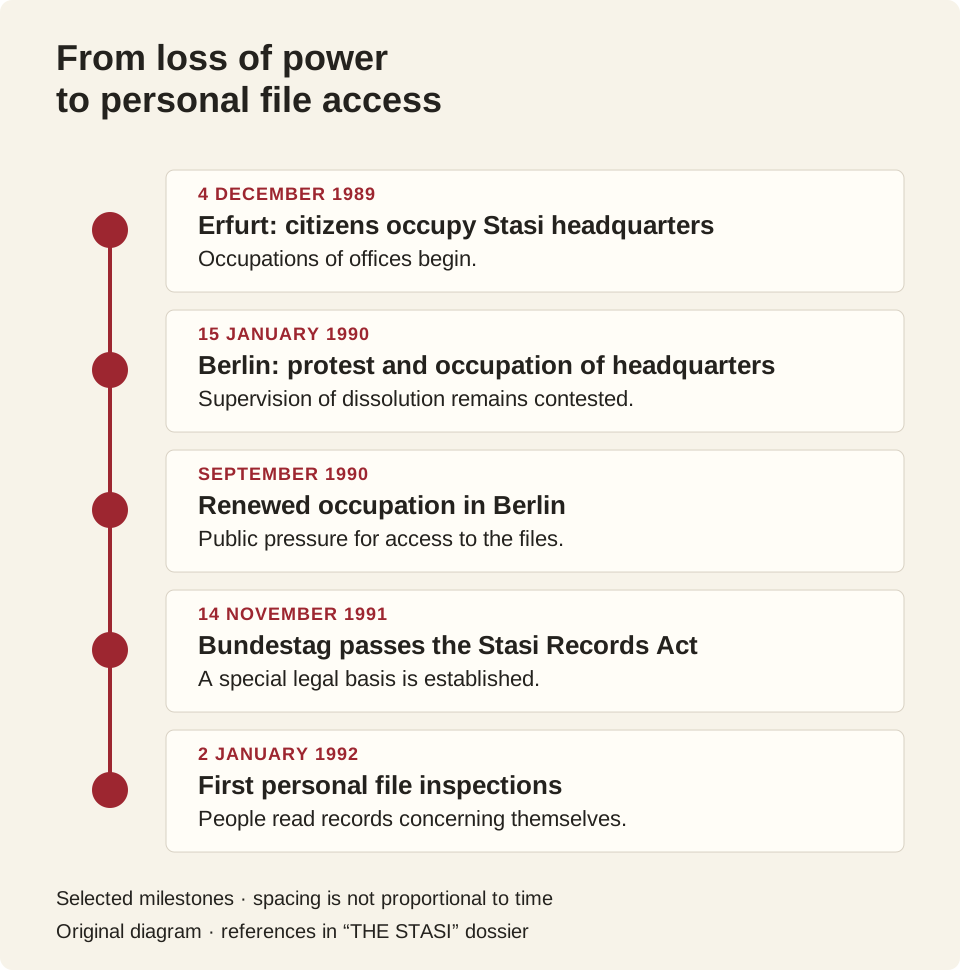
Access today and its significance for this website
In June 2021, responsibility for Stasi records passed to the Federal Archives.[41] The Stasi Records Act remains the basis for their use. The archive’s current overview distinguishes personal file inspection, requests from organisations and access for research and media. These different routes are subject to legal conditions.[44]
The documents I publish here can illustrate such access. They are selected traces of one individual life, supplemented by my recollections and historical research. The website aims to explain these sources in understandable context and make their origins traceable. Original records and archival research remain essential for an independent investigation.
After 1990 · responsibility, recognition and remembrance
Addressing the past and rehabilitation
Dissolving state security ended the apparatus’s work. However, questions of responsibility and the consequences of political persecution remained open. What could be prosecuted? How could unjust decisions be overturned? And how could those affected and later generations understand the past?
Criminal prosecution and its limits
In his 2016 retrospective, Jens Gieseke assesses criminal prosecution of Stasi injustice as largely unsuccessful. He identifies insufficient evidence, elderly accused people’s inability to stand trial and limits on criminal liability as reasons for the failure of many investigations. Even Erich Mielke’s conviction concerned the murder of two police officers in 1931, rather than his orders as Minister for State Security.[65]
Such an assessment answers questions about judicial punishment. Historical examination extends further: it also asks about political decisions, institutional structures and effects on those persecuted. The absence of a conviction does not explain these relationships. This website must therefore distinguish the criminal-law assessment of an individual action from examination of political responsibility.
Overturning unjust decisions
Rehabilitation focuses on those persecuted. Three legal foundations emerged in the early 1990s: the Criminal Rehabilitation Act of 1992 and the Administrative and Occupational Rehabilitation Acts of 1994. These different areas show that political persecution extended beyond criminal proceedings. It could also occur through administrative decisions and damage professional lives.[67]
For criminal judgments, Section 1 of the Criminal Rehabilitation Act defines the framework: it covers decisions by German state courts in the territory that joined the Federal Republic, from 8 May 1945 to 2 October 1990. On application, they must be overturned insofar as they contradict fundamental principles of a free order governed by the rule of law. The Act identifies, in particular, political persecution and a gross disproportion between legal consequences and the underlying act.[66]
Examination can also concern parts of a decision. This distinction matters particularly for judgments involving several charges: Section 1 contains provisions for full or partial annulment.[66] A judgment at the time and a later rehabilitation decision must therefore each be read as separate sources. Historical explanation of proceedings does not replace examination of their specific legal conditions.
My case: judicial rehabilitation in 1993
In my case, on 21 April 1993, Erfurt District Court declared the judgment of 11 April 1989 contrary to the rule of law and overturned it insofar as it concerned me. The decision covers the conviction for attempted unlawful border crossing and public denigration. It expressly states that the judgment served the purpose of political persecution and recognises my deprivation of liberty from 14 February to 20 October 1989 as unjust.[69]
The copy was certified on 26 May 1993. The earlier decision declaring enforcement inadmissible and the rehabilitation correspondence are documented alongside the decision in My rehabilitation — the judgment is overturned. This sequence documents the review of my own proceedings; other cases require their respective sources.
Advice and support in Thuringia
In Thuringia, the State Commissioner for the Study of the SED Dictatorship is a point of contact for questions about persecution, file access and rehabilitation. It offers assistance with applications and clarifying individual fates. The “SED Injustice Advice Initiative” working on its behalf combines information close to people’s homes with psychosocial support.[68] For people seeking to examine their own history, available options thus include personal support alongside the search for documents.
Overview of state information and advice services in Thuringia
Continuing to examine the history
Gieseke identifies personal file inspection, checks for Stasi cooperation, support for criminal prosecution and public historical discussion as the main pillars of addressing the past. He also warns against narrowing history to individual IM revelations and losing sight of other actors’ responsibility within the SED dictatorship.[65]
In Erfurt, Andreasstraße connects the prison’s history with later remembrance and educational work. Its development into a memorial is described in the chapter on Erfurt 1989 and remembrance. My personal documentation supplements this approach through one individual life. The dossier places it in historical context while leaving room for other experiences. Visitors can thus move from specific documents to further questions and sources.
Sources and references
Online sources were accessed on 1 October 2026 unless an individual reference gives a different checking date. Page numbers refer to printed pagination, rather than the PDF viewer’s page count; figures expressly identified as PDF pages are exceptions. The personal accounts on this website contain further explanations and the already published, redacted documents. German publication titles are retained in the references below.
View detailed source references
- Jens Gieseke: Von der Gründung bis zum Untergang, bpb, 2 January 2017, sections on background, expansion after 1961, détente and dissolution. Open source. ↩
- Walter Süß: Das Verhältnis von SED und Staatssicherheit. Eine Skizze seiner Entwicklung, BF informiert 17/1997, published by BStU, Berlin 1997, pp. 4–7 (founding legislation, statutes, political direction and direct leadership contacts). Open source. ↩
- Jens Gieseke: Wer war „Täter“?, bpb, 7 October 2016, section “Those bearing political responsibility: the SED’s party leadership and apparatus”. Open source. ↩
- Klaus Bästlein: Wer war Erich Mielke?, bpb, 2 November 2017, section 5, “17 June, the Stasi as scapegoat and Mielke’s rise to minister (1953–1957)”. Open source. ↩
- Federal Archives: Der Mauerbau in den Unterlagen der Staatssicherheit, introduction and sections on sealing the border, reporting and repression. Institutional presentation of sources. Open source. ↩
- Thomas Auerbach / Ilko-Sascha Kowalczuk: Zersetzung, MfS encyclopaedia, Federal Archives. Context for Directive 1/76 and its methods; the encyclopaedia text is a research account, rather than the directive itself. Open source. ↩
- Walter Süß: Die Staatssicherheit im letzten Jahrzehnt der DDR (MfS handbook), published by BStU, Berlin 2009, pp. 70–71 (differing practices of persecution and limits on influencing groups). Open source. ↩
- Federal Archives: Bezirksverwaltung (BV, BVfS), MfS encyclopaedia, sections on the 1952 reform, the line principle and tasks reserved for central units. Open source. ↩
- Thuringian State Agency for Civic Education: Das Ministerium für Staatssicherheit (MfS), sections on regional organisation and the Brandt–Stoph meeting on 19 March 1970. Institutional account. Open source. ↩
- Federal Archives: Stasi-Unterlagen-Archiv Erfurt, “Information and Documentation Centre” section, subsections on history, transit surveillance and border security. Institutional account. Open source. ↩
- Stiftung Ettersberg: Geschichte des Ortes, sections “Andreasstraße through change” and “The first occupation of a Stasi office in East Germany”, and the life story of Lorenz Pagés (checked again on 2 October 2026). Institutional account. ↩
- Johannes Beleites: Abteilung XIV: Haftvollzug (MfS handbook), published by BStU, Berlin 2009, facsimile reprint of the 2004 edition, pp. 9–11 (reading, outdoor exercise and visits) and pp. 61–62, “BV Erfurt” section. Research publication (PDF). ↩
- Federal Archives, Stasi Records Archive: Erfurt District Administration, Department IX (investigative body), holdings overview, December 2021, “General information” and “Includes, among other material”. ↩
- Federal Archives, Stasi Records Archive: Erfurt District Administration, Department XIV (pre-trial detention and penal custody), holdings overview, December 2021, “General information” and “Includes, among other material”. ↩
- Roger Engelmann / Frank Joestel: Hauptabteilung IX: Untersuchung (MfS handbook), published by BStU, Berlin 2016, pp. 11–14 (overview; development, isolation, contact with lawyers and covert measures); also the publication description on interrogation and the final report. Research publication (PDF). ↩
- MfS, Central Coordination Group: report no. 40/89 for 15 February 1989; archive reference in the existing publication: Federal Archives, Stasi Records Archive, MfS-ZKG no. 7639, appendix 21/4. Document and context; published entry about the Obst case. Primary source. ↩
- Erfurt-Mitte Local Court: judgment of 11 April 1989, case number 37 S 86/89 (also identified in the rehabilitation decision [69]), published first page; Mario V.W.B.R. Obst: Context and personal prison history. Redacted judgment page. The reproduced page bears the BStU sheet number 000027. The court case number and sheet numbering do not replace a complete archive reference; this remains to be cross-checked. ↩
- Stiftung Ettersberg: Lebensgeschichten, section on the overview of political prisoners and the distinction between the MfS and the People’s Police. Institutional account. ↩
- Jens Gieseke: Hauptamtlicher Mitarbeiter, MfS encyclopaedia, Federal Archives; personnel on 31 October 1989, growth and recruitment. Open source. ↩
- Helmut Müller-Enbergs: Inoffizieller Mitarbeiter (IM), MfS encyclopaedia, Federal Archives; tasks, estimate for 1989 and regional differences. Open source. ↩
- Roland Wiedmann: Kreisdienststelle (KD), MfS encyclopaedia, Federal Archives; territorial tasks and cooperation. Open source. ↩
- Roland Wiedmann: Postkontrolle, MfS encyclopaedia, Federal Archives; instructions, selection and processing of postal items. Open source. ↩
- Angela Schmole: Telefonüberwachung, MfS encyclopaedia, Federal Archives; technical development and analysis. Open source. ↩
- Angela Schmole: Beobachtung, operative, MfS encyclopaedia, Federal Archives; commissioning, operational line VIII and use of information. Open source. ↩
- Christian Halbrock / Ilko-Sascha Kowalczuk: Operativer Vorgang (OV), MfS encyclopaedia, Federal Archives; aims, action plans and possible outcomes. Open source. ↩
- Federal Archives, Stasi Records Archive: BV Erfurt, Abteilung 26 (Telefonüberwachung), holdings overview, December 2021, “General information”, “Includes, among other material” and “Information on processing the sub-holdings”; checked again on 2 October 2026. Open source. ↩
- Stiftung Ettersberg: Ort der Unterdrückung, sections on daily prison life in Erfurt, Harald Ipolt’s eyewitness account (imprisonment from June to December 1978) and descriptions of exercise yard photographs from 1989/1990. Institutional account incorporating personal recollection. Open source. ↩
- Karl Wilhelm Fricke: Kein Recht gebrochen? Das MfS und die politische Strafjustiz der DDR, APuZ 40/1994, 7 October 1994, sections III, “MfS pre-trial detention and fundamental rights”, and IV, “The practice of pre-trial detention”. Open research account. ↩
- Visiting permit for Rosemarie Obst, entry for 11 April 1989 at 13:30; handwritten list of items to bring. Previously published, redacted documents from my prison file. Visiting permit; List of items to bring. Also Mario V.W.B.R. Obst: The visit that could no longer take place, personal account on this website. The cancellation is described there; a complete archive reference and official cancellation note still need examination. ↩
- Peter Große / Barbara Sengewald / Matthias Sengewald: Erfurt machte den Anfang: Die Besetzung der Bezirksverwaltung der Staatssicherheit am 4. Dezember 1989, in: Hans Joachim Veen / Peter Wurschi (eds.): „Es lag was in der Luft …“. Die Besetzung der Bezirksverwaltungen des MfS/AfNS in Erfurt, Suhl und Gera, Stiftung Ettersberg, Weimar 2014, pp. 43–63. Used here: bpb extract Der 4. Dezember 1989 – der Tag der Besetzung, PDF pages 2–3 and 8–10. A compilation of memories and contemporary documents; the cited archival originals were not independently inspected. Open extract. ↩
- Eberhard Stein: „Sorgt dafür, daß sie die Mehrheit nicht hinter sich kriegen!“ MfS und SED im Bezirk Erfurt, Die Entmachtung der Staatssicherheit in den Regionen, Part 5, BF informiert 22/1999, published by BStU, Berlin 1999, pp. 39–43, particularly pp. 41–43 (working groups, citizens’ committee, citizens’ watch and safeguarding records). Open research publication. ↩
- Stiftung Ettersberg: Ort der Aufarbeitung, sections “A place of remembrance emerges” and on Barbara Sengewald and Harald Ipolt. Institutional account of subsequent use, preservation and opening of the memorial and education centre. Open source. ↩
- Laura Wehr: Vergessene Migrationsgeschichte/n? Die Ausreise aus der DDR in der Erinnerung von Übersiedler-Eltern und -Kindern, Deutschland Archiv, bpb, 14 December 2016, introduction and section “The emigration application”. Open research article. ↩
- Frank Wolff: Vom Mauerbau zum Mauerfall: 28 Jahre deutsch-deutscher Migrationsgeschichte, bpb, 4 November 2019, sections “Administrative foundations”, “The question of human rights” and “Weakened paper walls and the Peaceful Revolution of 1989”. Open research account. ↩
- Christian Halbrock / Ilko-Sascha Kowalczuk: Ausreisebewegung, Bekämpfung der, MfS encyclopaedia, Federal Archives, sections on Order 6/77, cooperation between authorities, “discouragement discussions” and criminal prosecution. Research account; the orders mentioned were not inspected as archival originals for this chapter. Open source. ↩
- Monika Tantzscher: Die verlängerte Mauer. Die Zusammenarbeit der Sicherheitsdienste der Warschauer-Pakt-Staaten bei der Verhinderung von „Republikflucht“, Series B: Analysen und Berichte 1/1998, published by BStU, Berlin 1998, p. 3 (cross-border cooperation) and pp. 18–19 (criminal provisions); also pp. 41–42 on cooperation with People’s Police investigative bodies. Open research publication. ↩
- Federal Archives, Stasi Records Archive: Zentrale Koordinierungsgruppe Flucht/Übersiedlung (ZKG), holdings overview, December 2021, “Tasks” and “Includes, among other material”. The holdings description explains responsibilities and surviving material; it does not replace examination of individual files. Open source. ↩
- Christian Booß: Geschichte ohne Masterplan: Der Sturm auf die Stasi 1989/90, bpb, 17 October 2016, particularly “Several strands of action” and “The actors of 15 January”. Historical reconstruction and expressly disputed assessment. Open research article. ↩
- Klaus Bästlein: Der 15. Januar 1990 – ein Stasi-Erfolg?, bpb, 15 January 2017, introduction and sections on the occupation and its consequences. A contrasting position to Booß’s assessment; the underlying archival originals were not independently inspected for this chapter. Open research article. ↩
- David Gill: Die (Ohn-)Macht der Bürgerkomitees. Die Rolle spontan engagierter Bürger bei der Entmachtung der Stasi 1989/90, bpb, 13 February 2018, sections on the supervisory role, the state dissolution committee and “Gradually drifting apart”. Retrospective account by a participant at the time, whose perspective is identified in the text. Open source. ↩
- Federal Archives: Rekonstruktion, particularly “Origins of reconstruction”, “How does manual reconstruction work?” and information on the transfer of responsibility in June 2021. Institutional account as consulted on 1 October 2026; no independent quantitative assessment of destruction. Open source. ↩
- German Bundestag: Vor 20 Jahren: Ringen um ein Stasiunterlagengesetz, 2011 web archive, introduction and “My file belongs to me”. Institutional retrospective on the People’s Chamber legislation, Unification Treaty and Bundestag decision of 14 November 1991. Open source. ↩
- Federal Archives: 30 Jahre Akteneinsicht: „Die Spuren der Diktatur“, press release of 11 January 2022, introduction concerning the first personal file inspections on 2 January 1992. Open source. ↩
- Federal Archives: Stasi-Unterlagen einsehen, overview of personal file inspection, requests and research/media access, consulted on 1 October 2026. Current institutional guidance on access, rather than individual legal advice. Open source. ↩
- Roger Engelmann: Diversion, politisch-ideologische (PID, PiD), MfS encyclopaedia, Federal Archives; emergence and use of the term to classify dissenting political views. Open research account. ↩
- Bernd Gehrke: Die 68er-Proteste in der DDR, APuZ, bpb, 18 March 2008, particularly “Extent and nature of the protests”; information on Erfurt’s Angereck and arrests. Research article; the underlying investigation files were not independently inspected. Open article. ↩
- Matthias Braun: Kulturbereich, Überwachung des Kulturbereichs, MfS encyclopaedia, Federal Archives; development after the Wall’s construction, Order 20/69, expansion in the 1970s and differing opportunities for intervention. Research account; the orders mentioned were not inspected as archival originals. Open source. ↩
- Federal Archives: „Staatsbürgerliche Pflichten grob verletzt“. Der Rauswurf des Liedermachers Wolf Biermann 1976 aus der DDR, description of the document publication, Berlin 2016. Used here: the institutional introduction on the publication page, rather than the complete document collection. Open publication description. ↩
- Jörg Echternkamp / Peter Lieb: Die Ahndung von NS- und Kriegsverbrechen in der SBZ/DDR, bpb, 25 November 2025, sections on Soviet military tribunals, special camps and the composition of prisoners. Historical account; individual internment files were not independently inspected. Open source. ↩
- Roland Wiedmann: K 5, MfS encyclopaedia, Federal Archives; the 1947 reorganisation, tasks, political orientation and activities in the regional states. Open research account. ↩
- Roger Engelmann / Walter Süß: Sowjetischer Geheimdienst, Verhältnis des MfS zum, MfS encyclopaedia, Federal Archives; the 1948 decision, establishment in 1949/50 and the changing balance of power in 1957/58. Open source. ↩
- Roger Engelmann: Berater, sowjetische, MfS encyclopaedia, Federal Archives; powers to issue instructions and veto decisions, personal direction and dissolution of the advisory apparatus in November 1958. Open source. ↩
- Helmut Müller-Enbergs: Hauptverwaltung A (HV A), MfS encyclopaedia, Federal Archives; predecessors, incorporation, designation from 1956, leadership and areas of responsibility. Open research account. ↩
- Helmut Müller-Enbergs: Spione beim Klassenfeind, bpb, 7 October 2016, sections “Why did East Germany spy in the West?” and “What did espionage achieve?”. Research account of aims, political influence and limits on effects. Open article. ↩
- Federal Archives: Stasi im Westen, introductory overview of responsibilities, recruitment, persecution and file destruction. Institutional account, accessed on 1 October 2026. Open source. ↩
- Federal Archives: Die Stasi in Bayern: Ingolstadt, section “The Audi plant under observation”, information about Umformtechnik Erfurt and document descriptions from 1985/1986. Used here: institutional text and descriptions; the complete underlying IM files were not independently inspected. Open source. ↩
- Stefan Wolle: Organisierte Misserfolge. Die Stasi als unsichtbare Alltagsmacht, bpb, 7 October 2016, sections “Special incidents”, “Checks” and “Organising professional failures”. Historical account of information flows, institutional discipline and professional interventions. Open article. ↩
- Federal Archives: „Rausgeschmissen“. Die Relegation von Schülern der Carl-von-Ossietzky-Schule, introduction and sections on expulsion proceedings and solidarity. Institutional account with document descriptions; the complete underlying files were not independently inspected. Open source. ↩
- Rainer Eckert: Lehren und Lernen unter MfS-Kontrolle: Lähmung der Universitäten, bpb, 7 February 2017, introduction and sections “Political-operational cooperation” and “Surveillance of academia and suppression of dissent”. Research account; the cited MfS implementing provision was not inspected as an archival original for this chapter. Open article. ↩
- Reinhard Buthmann: Volkswirtschaft, Überwachung der, MfS encyclopaedia, Federal Archives; tasks, cooperation, renaming in 1964 and security requirements for technological projects. Open research account. ↩
- Christian Halbrock / Ilko-Sascha Kowalczuk: Kirchen, Bekämpfung und Infiltration der, MfS encyclopaedia, Federal Archives; changing church policy, methods, church youth work and limits of infiltration. Open research account. ↩
- Johannes Beleites: Der verhasste Freiraum Kirche, bpb, 17 November 2017, sections on independent groups, church gatherings in 1983 and the more regulated relationship from 1978. Open research article. ↩
- Katharina Lenski: Sozialistisches Menschenbild und Individualität. Die „Offene Arbeit“ – ein Ort der Freiheit? Entstehung, Konzepte und soziale Praxis alternativer Jugendkultur im Staatssozialismus (1961–1989), Deutschland Archiv, bpb, 15 March 2017; passages on development in Thuringia and Erfurt and connections with the wider society. Research article; underlying archival holdings were not independently inspected. Open article. ↩
- Open Work Erfurt: Wir über Uns, 1 July 2020, information on its formation as a grassroots community/congregation in 1979. The community’s self-description, rather than an independent research account. Open self-description. ↩
- Jens Gieseke: Die Stasi-Aufarbeitung: Dauerthema oder Auslaufmodell?, bpb, 7 October 2016, sections “The pillars of addressing the Stasi past”, “Unsuccessful criminal prosecution” and “A completed task?”. Historical retrospective assessing research as at 2016; benefit amounts and plans for institutions’ futures given at the time are not adopted as today’s position. Open article. ↩
- Criminal Rehabilitation Act (StrRehaG), § 1: Aufhebung rechtsstaatswidriger Entscheidungen, particularly subsections 1, 3 and 4, official online version at Gesetze im Internet, accessed on 1 October 2026. Legislation as a primary source for the general framework; no assessment of individual proceedings. Open legislation. ↩
- Federal Agency for Civic Education: Rehabilitierung, transformation glossary, dossier Lange Wege der Deutschen Einheit, information on the three rehabilitation laws of 1992 and 1994. Explanation of the term, accessed on 1 October 2026. Open explanation. ↩
- Central Information and Referral Office (ZAuV): Übersicht Auskunfts- und Beratungsangebote – staatliche Institutionen – Thüringen, section “Thuringian State Commissioner for the Study of the SED Dictatorship (THLA)”. Institutional overview of advice and psychosocial support, accessed on 1 October 2026. Open overview. ↩
- Erfurt District Court, Second Rehabilitation Division: Beschluss vom 21. April 1993, II Reha 245/93, certified copy dated 26 May 1993, pp. 1–2. Personal collection of Mario V.W.B.R. Obst; the available digital copy was read. Pages 3–4 contain a historical information leaflet. Open redacted version. ↩
- Federal Archives: Der Aufstand im Bezirk Erfurt, virtual exhibition on the popular uprising, sections “Limited uprising in Erfurt” and “Demonstration in Sömmerda”. Institutional historical account, accessed on 1 October 2026; the underlying investigation cases were not independently inspected. Open source. ↩
- Christian Halbrock / Ilko-Sascha Kowalczuk: Volksaufstand im Juni 1953 und das MfS, MfS encyclopaedia, Federal Archives; causes, security bodies’ response and persecution. Online research account, accessed on 1 October 2026; orders cited there were not inspected as archival originals. Open article. ↩
- Torsten Diedrich / Hans-Hermann Hertle: Nach dem Volksaufstand vom 17. Juni 1953: Innere Mobilmachung der SED gegen das eigene Volk, extract on the bpb page Die Folgen des Aufstandes (Stefanie Wahl, 17 May 2013). Origin: introduction to Alarmstufe „Hornisse“, Berlin 2003, pp. 34–38; used here: the online extract on the police, factory security and operational command groups; the cited archival originals were not inspected. Open research account. ↩
- Stiftung Ettersberg: 7 Fragen an Silke Wilden, 2021/2022 annual report, pp. 92–95 (PDF pages 48–49, each a two-page spread). Biographical introduction and interview by Jochen Voit, September 2022; read in full, accessed on 2 October 2026. Wilden’s prison files were not independently inspected. Open interview and life story. ↩
- Günter Förster: Juristische Hochschule des MfS Potsdam (JHS), MfS encyclopaedia, Federal Archives; development, areas of study and practical training. Research account, accessed on 2 October 2026. Open encyclopaedia entry. ↩
- Federal Archives: Die Juristische Hochschule des Ministeriums für Staatssicherheit, description of Günter Förster’s research (MfS handbook, Berlin 1996), “Contents” section. Used here: the online introduction, rather than an assessment of the complete handbook; accessed on 2 October 2026. Open publication description. ↩
- Jens Gieseke: Schwarz, Josef, MfS encyclopaedia, Federal Archives; career, studies and leadership of the Erfurt District Administration. Biographical research account, accessed on 2 October 2026; his personnel file was not independently inspected. Open biographical entry. ↩
- Federal Archives, Stasi Records Archive: BV Erfurt, Leiter der Bezirksverwaltung, holdings overview, December 2021, sections “General information” and “Includes, among other material”; accessed on 2 October 2026. Description of responsibilities and surviving records, rather than independent examination of individual leadership cases. Open holdings overview. ↩
- Federal Archives, Stasi Records Archive: 1.5 Bezirksverwaltung (BV) Erfurt, sections “Structure of the Erfurt District Administration in 1989” and “The District Administration for State Security in Erfurt”; accessed on 2 October 2026. Used for the 1989 structure, the line principle and the 13 local offices. Open overview. ↩
- Federal Archives, Stasi Records Archive: BV Erfurt, Auswertungs- und Kontrollgruppe (AKG), holdings overview, December 2021, sections “General information” and “Includes, among other material”; accessed on 2 October 2026. Description of tasks and surviving records; individual subject files were not independently analysed. Open holdings overview. ↩
- Federal Archives, Stasi Records Archive: BV Erfurt, Abteilung M (Postkontrolle), holdings overview, December 2021, “General information” and “Information on processing the sub-holdings”; accessed on 2 October 2026. Open holdings overview. ↩
- Rüdiger Sielaff: „Zum Negativ-Feindlichen tendierende Positionen“ feststellen – die Postkontrolle, in: Peter Boeger / Elise Catrain (eds.), Stasi in Thüringen. Die DDR-Geheimpolizei in den Bezirken Erfurt, Gera und Suhl, BStU, Berlin 2018, pp. 76–80, here p. 76 with notes 251–253 and p. 80 with notes 264–267. The published account is used; original files cited there were not independently inspected. Open publication (PDF). ↩
- Federal Archives, Stasi Records Archive: Codename „Konfrontation“. Erstes deutsch-deutsches Treffen: Willy Brandt trifft Willi Stoph in Erfurt, sections “Background to the meeting” and “The day of the visit”; accessed on 2 October 2026. Institutional contextualisation. Open account. ↩
- Elise Catrain: 1970. Stasi-Aktion „Konfrontation“ – Willy Brandt in Erfurt, in: Peter Boeger / Elise Catrain (eds.), Stasi in Thüringen, BStU, Berlin 2018, pp. 28–31, particularly pp. 28–29 on preparation and mail interception and p. 31 on subsequent identification. The research account and its archive references are used. Open chapter (PDF). ↩
- MfS, ZAIG: Abschlussbericht zur Aktion „Konfrontation“, 15 April 1970, BArch, MfS, ZAIG, no. 11404, sheets 2–40. Parts of the online transcript read: opening assessment and breakdown of the 119 instances of people being taken in. Official source; not a complete assessment of all 39 document pages. Open report; View breakdown. ↩
- Elise Catrain: Haft für Eisenacher Familie – das Stasi-Gefängnis „Andreasstraße“, in: Peter Boeger / Elise Catrain (eds.), Stasi in Thüringen, BStU, Berlin 2018, pp. 85–87, here pp. 85–86. Research account with file references and eyewitness interviews; the complete family files were not independently inspected. Open chapter (PDF). ↩
- Florian Lipp in conversation with Dagmar Hovestädt: DDR-Punks und die Stasi, “111 Kilometer Akten” podcast, episode 60 of 18 May 2022, Federal Archives, transcript read: classification procedures, performance permits and differing cultural-policy treatment in the 1980s. Research discussion; no claim to have read his dissertation in full. Open discussion and transcript. ↩
- Stephanie Schlesier: Die „operative Bearbeitung“ – Punkbands im Visier der Stasi, in: Peter Boeger / Elise Catrain (eds.), Stasi in Thüringen, BStU, Berlin 2018, pp. 72–75, here pp. 72–73 with notes 244–246. Research account of the band and the cases “Friseur”, “Laien” and “Schlagzeug”. Open chapter (PDF). ↩
- Federal Archives: Besondere humanitäre Bemühungen, background information on the edition of documents from 1963–1969. Online account read; not a complete assessment of the edition. Open account. ↩
- Jan Philipp Wölbern: Der Häftlingsfreikauf aus der DDR, in: BStU (ed.), Staatssicherheit. Ein Lesebuch zur DDR-Geheimpolizei, Berlin 2015, here pp. 160–163. Research account read; underlying negotiation files were not independently analysed. Open chapter (PDF). ↩
- Federal Archives, Stasi Media Library: Abteilung XII (Zentrale Auskunft, Speicher), organisational account; tasks, regional structure and registration categories. Online account read; registration instructions were not independently analysed. Open account. ↩
- Doreen Hartwich: F 16 (Personenkartei), MfS encyclopaedia, Federal Archives. Explanation of fields and connection with the case index. Open entry. ↩
- Doreen Hartwich: F 22 (Vorgangskartei), MfS encyclopaedia, Federal Archives. Explanation of separation, recording and archive references. Open entry. ↩
- Federal Archives, Stasi Records Archive: BV Erfurt, Abteilung XII (Auskunft, Speicher), holdings overview, December 2021; tasks, contents and processing of the sub-holdings. Description read; individual subject files were not independently inspected. Open holdings overview. ↩
- Helmut Müller-Enbergs: Werbung, MfS encyclopaedia, Federal Archives; preparation, contact discussions and bases for recruitment. Online research account read; individual recruitment reports were not independently analysed. Open entry. ↩
- Helmut Müller-Enbergs: Verpflichtung, MfS encyclopaedia, Federal Archives; written and oral declarations of willingness. Open entry. ↩
- Helmut Müller-Enbergs: IM-Vorgang, MfS encyclopaedia, Federal Archives; personnel files, working files, IM preliminary cases and the special arrangement for IMK. Explanation read; Directives 1/68 and 1/79 were not fully analysed for this section. Open entry. ↩
- Helmut Müller-Enbergs: Inoffizieller Mitarbeiter zur Sicherung der Konspiration und des Verbindungswesens (IMK), MfS encyclopaedia, Federal Archives; tasks and distinctions in logistical support. Open entry. ↩
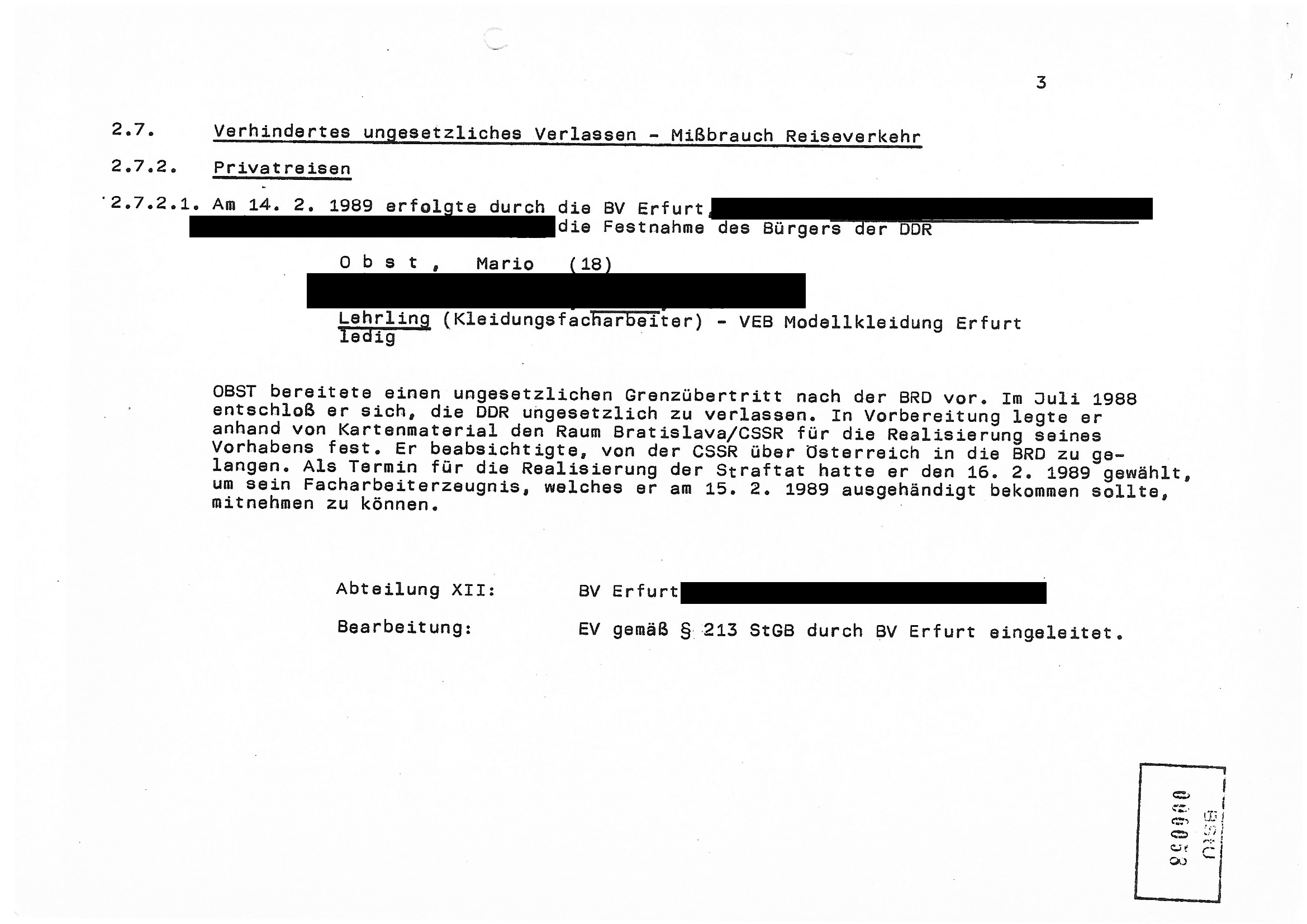
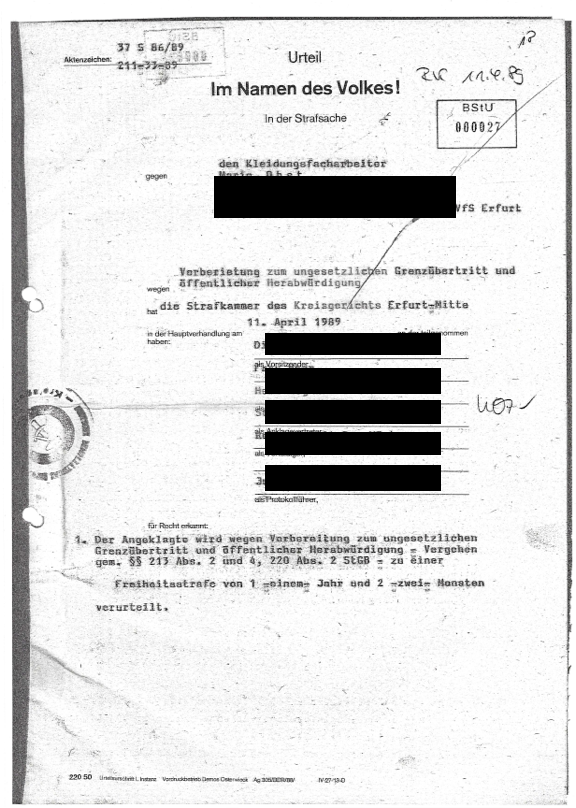
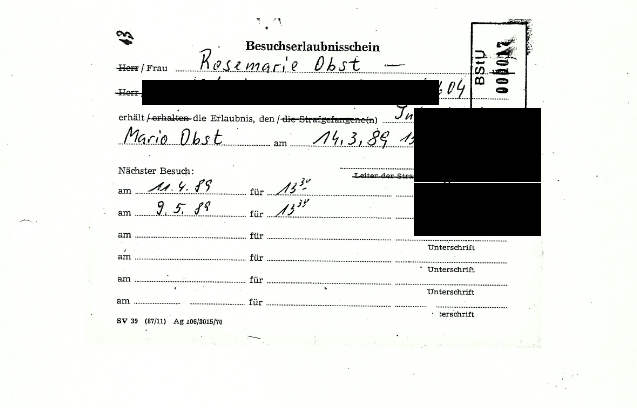
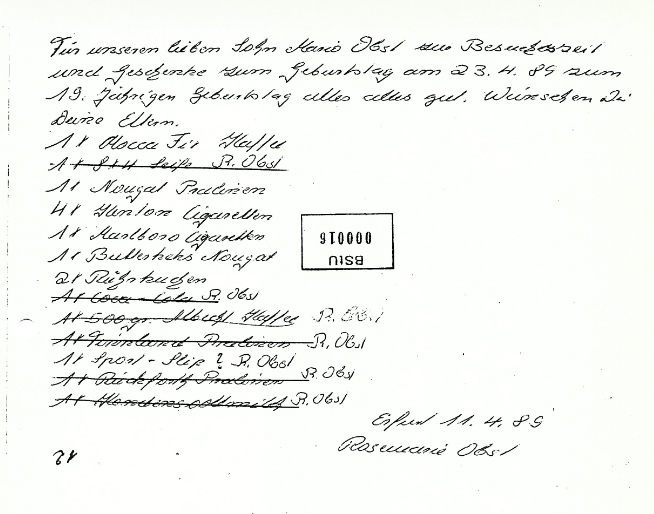
Limits of this account
The total number of prisoners and its precise reference group still need to be reconciled: previous research produced figures of 5,039 Stasi remand prisoners and over 5,500 people. The pages “Life stories” and “Place of oppression”, read again on 2 October 2026, give 5,523. An explanation of the differing versions and examination of the reference groups remain outstanding. No total is therefore used here yet. Capacity figures in the handbook also need comparison before being represented graphically.
Unsupported details of daily prison life are omitted: a fixed daily schedule, the conditions of my admission and specific interrogation methods in my case are not reconstructed without additional evidence. The judgment’s court case number is documented in the rehabilitation decision; the complete archive reference remains to be cross-checked. Documented facts and personal recollections are identified separately.
Citation guidance: Mario V.W.B.R. Obst: THE STASI — history, pre-trial detention in Erfurt and political persecution, stasi-prison.com, as at 2 October 2026. For individual statements, please identify the relevant chapter and corresponding reference. When using an original source, also identify its author or issuing institution.